When Will Your Child Sleep Through the Night? A Realistic Guide
“When will they finally sleep?” — a question that returns every evening like a boomerang
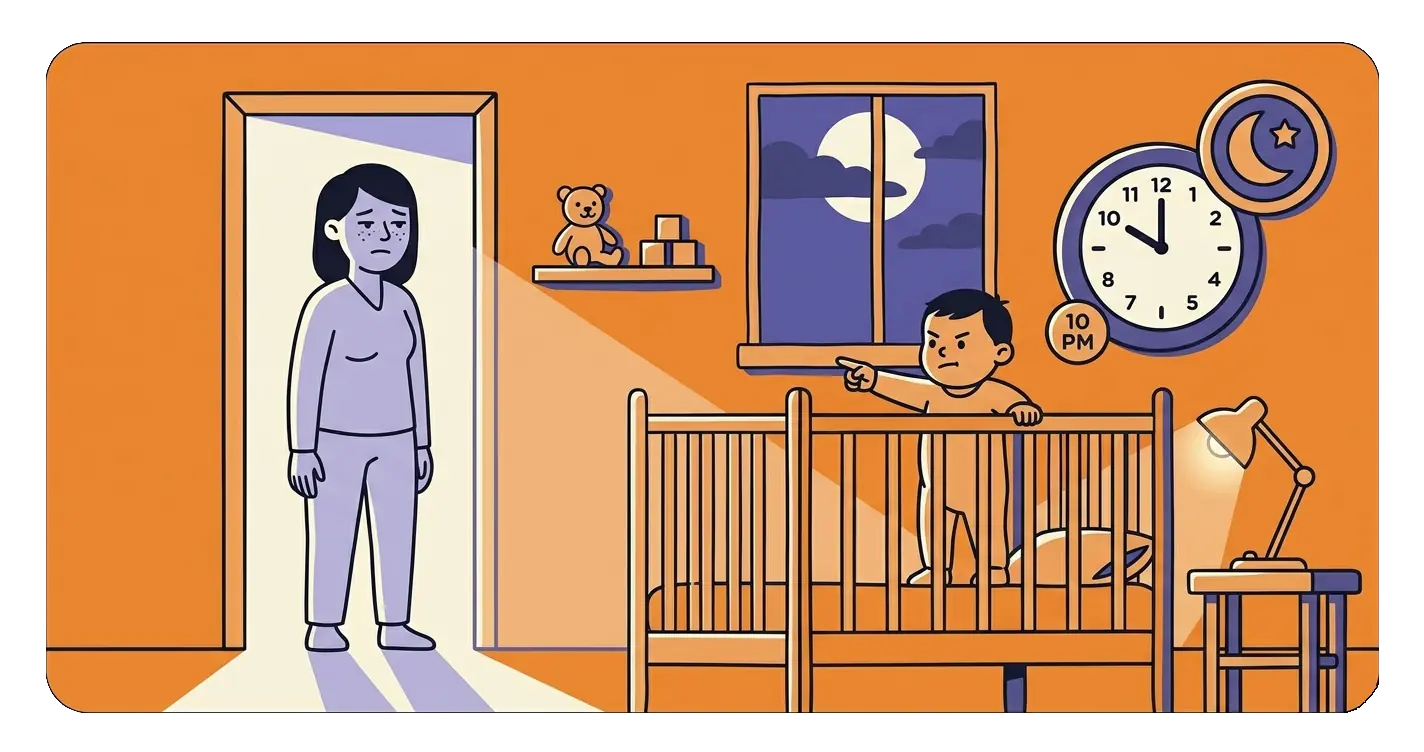
“Our friends' child sleeps until morning, but ours woke up again at 2:13 and 4:47. Are we doing something wrong?” Parents often tell us this. From our experience, the greatest exhaustion doesn't just come from the wake-ups themselves, but from hearing different versions of what should supposedly already be happening. 😴
In practice, we see that even the phrase “sleeping through the night” can cause confusion. For one parent, it's 6 hours without a call, for another, a full night from evening to morning, and for someone else, no feeding after midnight. No wonder it's easy to feel lost.
We take a more human approach. If your child is having increasingly longer sleep stretches, and you don't have to get up every hour, that's progress — even if the “perfect night” is still far off. And no, it doesn't mean you've failed.
In this article, we'll show you: - what can truly be considered sleeping through the night, - what to expect at different stages, - what often disrupts longer sleep, - how to support a peaceful night without pressure and without comparing yourself to others 🌙
What do we actually mean by “sleeping through the night”?
Parents often imagine: the child falls asleep in the evening, opens their eyes in the morning, and that's it. However, in our work with families, we much more often talk about the longest peaceful stretch of the night, rather than perfect silence for 10–12 hours. It's simply more realistic.
From our experience, it's helpful to think about it in three simple steps:
- 5–6 hours straight — for many infants, this is already a significant leap
- about 8 hours — appears later and gradually for some children
- the whole night without your help — can be possible, but it's not a mandatory “milestone”
In practice, we observe that parents often don't notice improvement because they focus on the fact that the child still wakes up. Yet, if there were four wake-ups before and now there's one or two, the night already looks completely different. That's also a change for the better.
It's important to remember that short awakenings between sleep cycles are normal. Adults have them too; we just usually don't remember them. The most important thing is not whether the child moved or opened their eyes, but whether they can return to sleep without a long nighttime routine. 😴
If you have a little one in the first months of life, nighttime feedings are usually just part of this stage. Later, many children begin to extend their first nighttime stretch, but the pace can vary greatly. In our work, we often see two children of the same age whose nights look like they're from two different planets — and that can still be okay.
What usually falls within the norm at different stages?
The most tension arises when a parent hears a specific date and treats it like an exam deadline. But sleep doesn't work that way. From our experience, the development of nighttime sleep is more like a wave than a straight line — a bit forward, sometimes a step to the side, sometimes a temporary setback. 🌙
0–3 months: It's really not about a “full night's sleep” yet
At this stage, most parents are simply in survival mode. The child is just getting used to the world, and their body doesn't yet operate according to a clear day-and-night division. If they sleep for a few hours, wake up to eat, and fall asleep again, this is usually quite typical.
In practice, simple things help from the start: - in the morning, daylight and a regular start to the day, - normal household noises during the day, - less noise and softer light in the evening, - a short, repeatable signal that night is beginning.
This doesn't work miracles after one evening, but it helps the child gradually catch the rhythm.
3–9 months: often the first sigh of relief appears
This is the stage where many parents tell us for the first time: “Okay, something's shifted.” For some children, the night begins to settle into longer blocks. For others, it's still uneven, but it's clear that sleep is becoming less chaotic.
From our experience, this is where giving yourself 7–14 days of calm consistency works well. Similar wake-up time, a fairly predictable day, a calmer evening — and only then assess whether it's improving. Not after two nights, but after a piece of time.
We once had a family convinced that “nothing works” because the child still woke up at night. When we mapped out the nights from the last two weeks, it turned out that from waking every 2 hours, it became one long block of sleep and one short wake-up in the early morning. The parents were so exhausted they didn't even notice. This happens more often than you think.
9–12 months and 1–3 years: longer sleep yes, but still with twists
At this age, many children already sleep quite long, but that doesn't mean the issue disappears forever. In practice, wake-ups often return due to developmental tension, the need for closeness, or because the child has become accustomed to specific help in falling asleep.
If nights become more difficult, it's worth checking: - whether the child is truly waking from hunger, - whether they eat enough during the day, - whether falling asleep relies mainly on one form of help, which they then seek at night.
This is the stage where parents often say: “But it was already good!” And yes — it can be frustrating. But from our experience, such relapses don't necessarily mean everything has fallen apart.
4–10 years: usually calmer, but not always perfect
Older children generally sleep more steadily, though tougher evenings, nighttime calls, nightmares, or very early wake-ups can still occur. In practice, a common culprit is a disrupted routine, too much stimulation at the end of the day, or too late a bedtime.
If the problem concerns an older child, it's worth looking at: - bedtime and wake-up time, - screens before bed, - how the last hour of the evening looks, - whether the child has been functioning on too little sleep for a long time.
And if it's still difficult for you, it's really not “strange.” In our work, we hear such stories regularly.
Why does one child sleep longer earlier, and another much later?
This question comes up very often, especially when comparisons among friends begin. From our experience, the answer almost never is: “because one is well-behaved and the other is not.” A child's sleep is a mix of temperament, developmental stage, daily rhythm, and current needs. 🌙
A lot is gained from the daily routine. It's not about living according to a minute-by-minute schedule, but about giving the child clear signals: now it's day, now activity, now winding down, and now night.
In practice, it usually helps: - bright morning and exposure to light after waking up, - regular activity during the day, - a calmer evening, - roughly predictable nap, feeding, and nighttime sleep times.
The effect usually takes a moment to appear. We usually ask parents to give changes a few days to 2 weeks before deciding if something is working or not. A child's sleep rarely reacts immediately.
The second important matter is food. For younger infants, nighttime feeding may simply be a need. For older children, we look more broadly: is there really enough caloric intake during the day, and has the night become a place for “catching up” or calming down.
If the child wakes up frequently, it's good to ask yourself three simple questions: 1. Are they actually hungry? 2. Has feeding become a shortcut to falling back asleep? 3. Is the day organized enough for the night to have a chance to extend?
In our work, we also see very clearly that nights tend to fall apart during teething, infections, learning to sit, crawl, walk, or during periods of greater need for closeness. It's usually not “broken sleep,” just a stage that requires a bit of patience.
When are wake-ups still normal, and when is it worth stopping to check more?
Parents often ask us directly: “Is this still normal or already a problem?” And honestly — we really like this question because it truly helps to look more broadly. The number of wake-ups alone doesn't tell the whole story. It's also important how the child looks during the day and how calming down at night goes.
If the little one is developing well, has contact with the environment during the day, eats fairly normally, and can be soothed predictably after waking, nighttime waking often still fits within the usual developmental picture. Especially when we're talking about an infant.
What usually doesn't need to worry you right away? 🌙
In practice, we often see: - short awakenings between sleep cycles, - worse nights during teething or infection, - temporary worsening after travel or a change in the daily plan, - more wake-ups during a developmental leap.
These are situations where the night can be tougher, but the context explains a lot.
When is it first worth contacting a doctor? 🚩
There are also moments when we don't start with a sleep plan but with checking the child's health. It's worth doing this if, for example, there are: - breathing difficulties, - clear pain, - fever and weakness, - increased anxiety after feeding or when lying down, - sudden and significant change in sleep along with a decrease in appetite.
In such situations, we first want to be sure that the child isn't struggling with physical discomfort.
What do we often discuss during consultations?
During a sleep consultation, we most often look at situations such as: - very frequent wake-ups without a clear pattern, - difficulty falling back asleep even though it doesn't seem like hunger, - falling asleep only possible in one specific way, - very late entry into the night, - regular early morning wake-ups, for example before 5:00.
From our experience, these early wake-ups often have specific causes: too late a bedtime, poorly timed naps, or too bright a start to the day. This can be broken down into components.
How to support longer nighttime sleep without stressing about perfection?
If we have to point out one thing that's really worth starting with, it would be the day. In practice, the night rarely improves on its own if the day is completely random. An infant who sometimes has very long wakefulness and other times falls asleep whenever usually brings that chaos into the night as well. 🌙
That's why we encourage parents to simply observe for 4–5 days: - what time the child wakes up, - when they become cranky or clearly sleepy, - what naps look like, - how long it takes to fall asleep in the evening, - how the night goes after such a day.
It doesn't have to be a beautiful table. A note on your phone is really enough.
Naps matter more than you think
In our work with families, we regularly see two extreme scenarios. Either the child has naps so late that they're not ready for night in the evening, or they're so tired that they fall asleep “on fumes” and then sleep lightly and restlessly.
It's especially worth looking at the last nap. If it ends very close to nighttime sleep, the evening can drag on. Conversely, if there's too long a wakefulness between the end of the nap and night, the child may enter the evening overstimulated.
Consistency usually beats trying to figure things out
Three things usually help: 1. a fairly similar morning wake-up time, 2. a repeatable daily routine, 3. an evening that looks more or less the same every day.
We usually give 1–2 weeks for improvement, not two days. From our experience, parents often give up just before the moment when the child's body starts to catch the new rhythm.
How to help your child transition better from one sleep cycle to another?
This is one of those topics that makes a huge difference. In practice, we see that it's easier for a child to return to sleep when, after a short awakening, they encounter conditions similar to those in which they fell asleep. If they fell asleep being rocked, at the breast, or only in arms, they will often seek that after waking. And it's not because they're “manipulating,” but because that's how they know the way to sleep. 🌙
We don't like scaring with “bad habits.” We much prefer thinking: can what works in the evening be realistically repeated at 1:40 in the night? If not, it's worth looking for a gentler solution.
An evening routine that makes sense
It doesn't have to be long or Instagram-worthy. In practice, a ritual lasting about 20–30 minutes that looks similar every day works best.
It could be: - dimming the lights, - a slower pace, - washing or bathing, - feeding or dinner, - a short book or lullaby, - a simple signal that now we sleep. 💤
In many families, the first change in falling asleep is visible after a few days, and a fuller improvement after 2–3 weeks. This is a fairly typical rhythm.
How to reduce help with falling asleep without a big revolution?
Parents often fear that any change means a lot of crying and leaving the child alone. We don't approach it that way. From our experience, small, calm steps work best.
You can try: 1. for a few evenings rocking a little shorter, 2. then shortening carrying by a few minutes, 3. if feeding ends with sleep, slightly separating the moment of eating from the moment of sleep, 4. putting the child down more often when they're very sleepy but not yet fully asleep.
We also had a family who was sure that without 25 minutes of carrying, their son wouldn't fall asleep at all. They started by shortening this time by 3 minutes. Then by another 2. After less than three weeks, falling asleep looked completely different, and the parents said that what helped them the most was that no one told them to do everything at once.
The most common things that unintentionally make the night harder
A very common problem is putting the child to bed too late. This can be misleading because an overtired child doesn't always look sleepy. Sometimes that's when they become most active, loud, and “as if they suddenly got a second wind.”
If evening falling asleep regularly takes a long time, it's worth moving the night earlier by 15–20 minutes for 4–7 days and seeing what changes. It's a small move, but in practice, it often makes a surprisingly big difference. 🌙
The second thing is large irregularity of the day. Once waking up at 6:00, once at 8:15, once a nap late in the afternoon, once without a nap — for some children, it's just too much chaos. It's not about rigidity, but about clarity.
It usually helps: - a similar wake-up time, - roughly predictable naps, - the same evening ritual, - a calmer last 45–60 minutes of the day.
The third common topic is strong dependence on one form of falling asleep. If the same support is needed for every sleep, the child may seek it also after nighttime awakenings. This doesn't mean you have to cut everything off starting tomorrow. From our experience, a change spread over 1–3 weeks works much better.
What to do when your child suddenly starts waking up again?
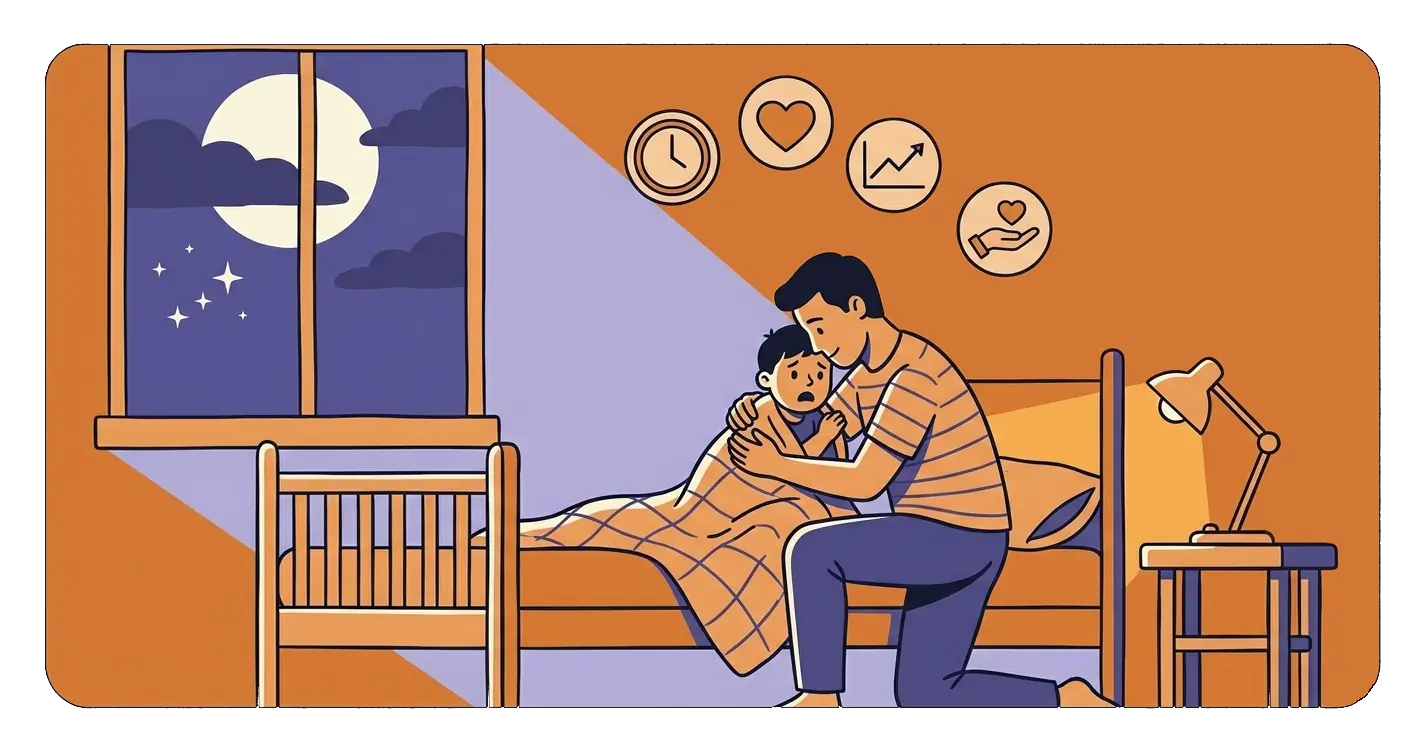
This is the moment when many parents feel anger and helplessness. “It was going so well, and now everything from the beginning again.” In practice, such a sudden worsening very often has a specific reason: illness, teething, travel, guests, a new skill, a greater need for closeness. 😴
For the first 3–7 days, we usually propose a simple plan: - check if the child has any symptoms of illness or pain, - think about what has changed recently, - see if the difficulty concerns only the night or also the day, - note down sleep and wake-up times for a few days.
If nights were fairly stable before, it's usually worth returning to basics: a calmer evening, a predictable day, and a similar bedtime. In our work, we often see that such a fresh “breathlessness” passes after a few days or within 1–2 weeks.
However, if the problem persists, you're becoming increasingly exhausted, or every night feels like a lottery, then it's really worth looking at the topic more broadly. Sometimes a few small adjustments make a bigger difference than weeks of guessing.
A few myths that only add stress to parents
One of the most common myths is the belief that it's enough to “feed well at night,” and the child will immediately sleep until morning. From our experience, nights are much more complex. Hunger can be one of the elements, but alongside it often stand fatigue, the way of falling asleep, and the developmental stage. 💤
The second popular myth is: “if you cut naps, the night will improve”. In practice, very often the opposite happens. An overtired child usually sleeps more restlessly and wakes up more frequently.
If after cutting naps for 3–5 days the night becomes noticeably worse, that's usually a signal for us that the body is saying: “not in this direction.”
The third myth is the belief that every child has the same moment when they “should” start sleeping through the night. In our work with hundreds of families, we see more diversity than one common calendar. And honestly? This often brings the greatest relief to parents.
Summary: when does a child sleep through the night and when is it worth seeking support
If you feel like everyone around you is talking about wonderfully slept nights, and it's still tough for you, we want to say this very clearly: you're not alone in this. From our experience, a child's nighttime sleep matures unevenly, and improvement often comes in stages rather than one big breakthrough. 🌙
Most often, it helps: - a more predictable daily rhythm, - a calmer evening, - a short and repeatable bedtime ritual, - gradually reducing help with falling asleep if that's what's maintaining the wake-ups.
Parents often notice the first small changes after 3–7 days, and a more stable effect usually after 2–3 weeks. However, if nights are very difficult, something worries you, or you're simply fed up with guessing — that's really a good moment to ask for support. 🤍
If you want, we can help you organize this step by step and tailor a plan to your child, not to general slogans from the internet. Check out our SleepComplainer consultation form: sleepcomplainer.com/SleepAssessment