Developmental Leap and Your Child's Sleep — Night Wakings and Daily Routine Changes
Suddenly, the Night Falls Apart — What Now?
“Things were going well, and now it's back to frequent wakings?” — this is one of the most common questions we hear from parents. Add to that shorter naps, more resistance at bedtime, and the feeling that your child doesn't know whether to sleep or fight fatigue 😵💫
From our experience, such sudden disruptions often occur when a child enters an intense developmental phase. Suddenly, they're practicing something new, reacting more strongly to separation, finding it harder to calm down, and sleep becomes much less predictable than just a few days ago.
In practice, we see this particularly around 4–5 months, 6–9 months, around 12 months, then between 15 and 18 months, and later around 2 and 2.5–3 years of age. This isn't a rigid calendar, but rather indicative moments when many children start sleeping differently than before.
In this article, we'll show you how to look at the situation calmly. Without guessing, without upheaval, and without assuming that 'everything's broken' 🌙
How to Recognize That Development is Disrupting Sleep?
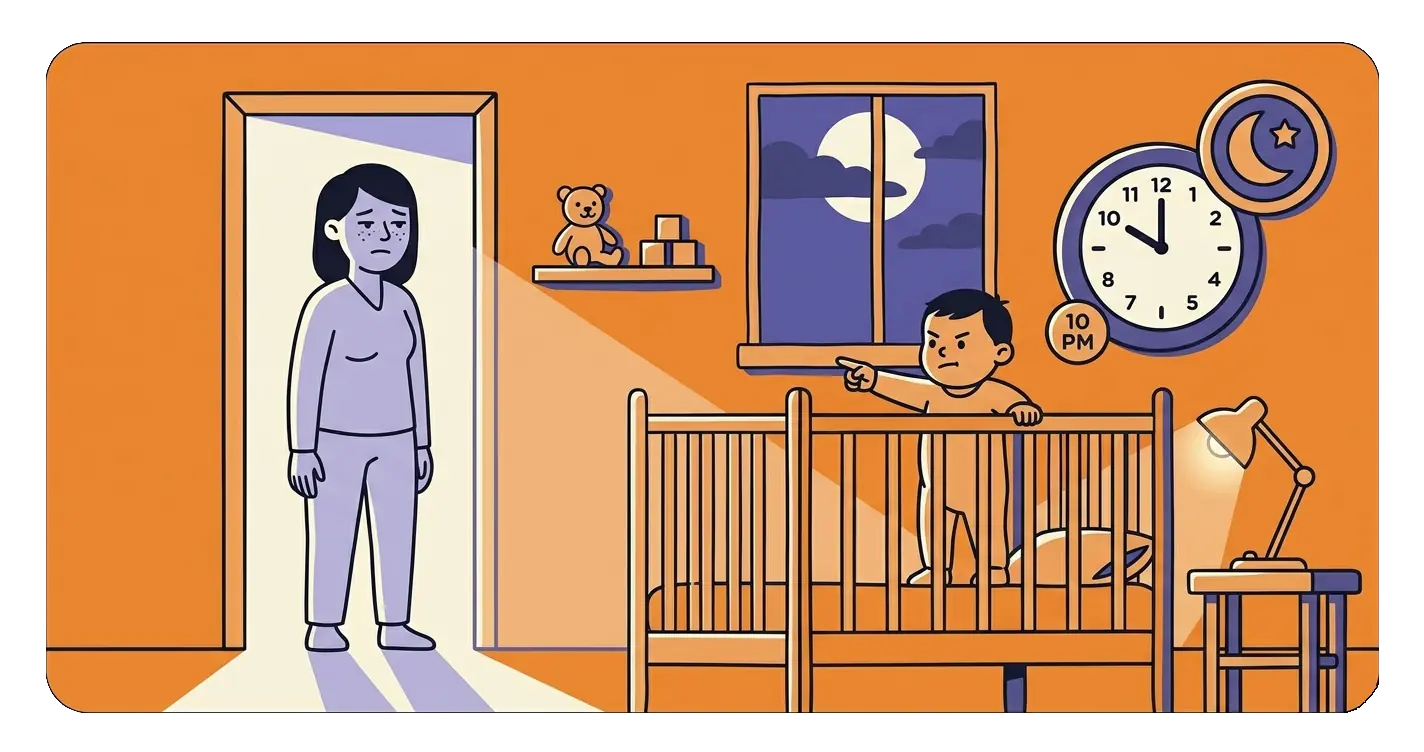
Parents often notice this very suddenly. Not long ago, the child was falling asleep relatively easily, and now they're waking more at night, shortening naps, or crying when put down. Sometimes there's also an earlier morning wake-up and a more challenging evening.
In our work with families, we often see a similar set of signals: - more night wakings than usual, - shorter or less stable naps, - greater resistance at bedtime, - a noticeably greater need for closeness, - evening irritability despite tiredness.
Additionally, there's often 'training' of new skills at the least convenient moment. The child rolls over, sits up, pulls up, tries to stand, or simply can't stop practicing, even when they really should be sleeping. From our experience, it's one of those moments when a parent looks at the monitor and thinks: “Really, now?”
It's also important to remember one crucial thing: worse sleep doesn't necessarily mean the child suddenly needs less of it. In practice, we more often see that sleep is still needed, but harder to achieve. The child is more stimulated, gets 'wound up' faster, and finds it harder to wind down the day.
When Is It More Likely a Leap, and When Is It the Daily Routine?
Here, it usually helps to look at the whole picture, not just one night. If the change came overnight and is quite chaotic, it often indeed involves a developmental stage. One night there are two wakings, the next four, then a very early morning appears, and everything seems a bit random.
On the other hand, when the problem mainly stems from the daily routine, difficulties are usually more repetitive. A nap falls apart at a similar time, evening bedtime drags on every day, or night wakings return in a similar pattern. This looks more like a rhythm to be adjusted than a temporary developmental disruption.
Parents often ask us what to look at first. We usually ask them to keep track for 3–5 days of not just the night, but also: - wake time length, - nap length, - mood in the evening, - new skills, - method of falling asleep.
Such a simple record really shows a lot. In practice, often after just a few days, you can see whether it's temporary instability or if the daily routine has started to unravel.
From our experience, one very helpful question is: is there a change during the day too? If the child is more 'clingy', intensely practicing something new, reacting more strongly to separation, or finding it harder to calm down, we usually have a strong hint that development is playing a part.
Or Could It Be Teething or Illness Instead of a Leap?
This is an important question because not everything should be lumped together. When development is behind poor sleep, the child often seems more stimulated than sick. They're tired but also 'revved up', and instead of letting go in bed, they try to keep going.
With teething, we usually see more physical discomfort. The child bites more, drools more, gets irritated more easily, and sometimes everything is 'too much' for them in the evening. This is a slightly different picture than typical developmental stimulation.
With illness, the signals are usually even more clear. The child not only sleeps worse but also functions worse during the day. They have less energy, eat less, are apathetic, or clearly suffering.
When Is It Worth Stopping and Checking More Broadly?
If you see any of these signals, don't immediately assume it's just a phase: - fever, - obvious pain, - increased runny nose or cough, - loss of appetite, - lack of energy, - crying that's completely unlike everyday fussiness.
In practice, we recommend a simple review of the last few days. Check how daytime sleep looked, if any physical symptoms appeared, if the routine hasn't changed, and if the child behaves 'normally' outside of sleep. Often, after 2–4 days, you can see which way things are heading.
At What Moments Does Sleep Most Often Wobble?
From our experience, there are stages when parents particularly often write to us with the same issue: “Suddenly everything fell apart.” This often happens around 4–5 months, 6–9 months, around a year, then between 15 and 18 months, and later around 2 and 2.5–3 years.
This doesn't mean, of course, that every child will go through these moments the same way. One will sleep a bit worse for three days and return to balance. Another needs a week or two to get back into rhythm.
In our work with families, we most often see that such transitional worsening lasts from a few days to about 2 weeks. However, if the situation drags on for more than 2–3 weeks, it's usually worth looking at the issue more broadly. Then development is often just part of the puzzle.
We remember a family where everything looked like a typical leap: sudden wakings, short naps, greater need for closeness. After a more detailed breakdown of the day, it turned out that the last wake time had also significantly lengthened. A small evening adjustment made a huge difference there.
What to Change in the Daily Routine to Avoid Making Things Worse?
When sleep starts to wobble, it's very tempting to immediately rearrange the whole day. From our experience, this is usually not the best direction. Small, calm adjustments work much better than a big change all at once.
The following actions usually help: - shortening wake windows by 10–20 minutes for a few days, - responding faster to the first signs of tiredness, - putting to bed earlier by 15–30 minutes if the day was fragmented, - a calmer afternoon without adding too many stimuli.
In practice, we often see parents trying to 'hold out' the child longer, assuming they'll sleep better then. But the opposite happens: the child gets even more stimulated, and falling asleep becomes harder. If you see a lot of fussing, tossing, and fighting sleep in the evening, it's usually not a good time to extend the day.
From our experience, the principle works particularly well: first take a step back, then observe. Give the change 2–3 days and only then assess if something is improving.
What About Naps — Shorten, Drop, or Save?
This is one of those topics where parents most often want to act quickly. We understand this because when a child refuses a nap or sleeps for 25 minutes, it's easy to think: “Okay, maybe they're outgrowing it.” In practice, it often turns out to be just a temporary wobble.
We usually advise against hastily dropping a nap after 1–2 tougher days. If the child is clearly tired and the problem appeared suddenly, it's worth first assuming it's a phase, not a permanent change in needs.
What can you do instead? 1. offer the nap a little earlier than usual, 2. if the nap was very short, try to save the day with extra rest or an earlier night, 3. observe for 2–3 days instead of judging after one day.
In our work with families, we regularly see this scenario: the child refuses one nap for two days, and on the third day, they fall asleep on it without a problem. That's why it's really worth giving it a moment before deciding it's time for a bigger schedule change.
Evening and Night — How to Provide More Support Without Chaos?
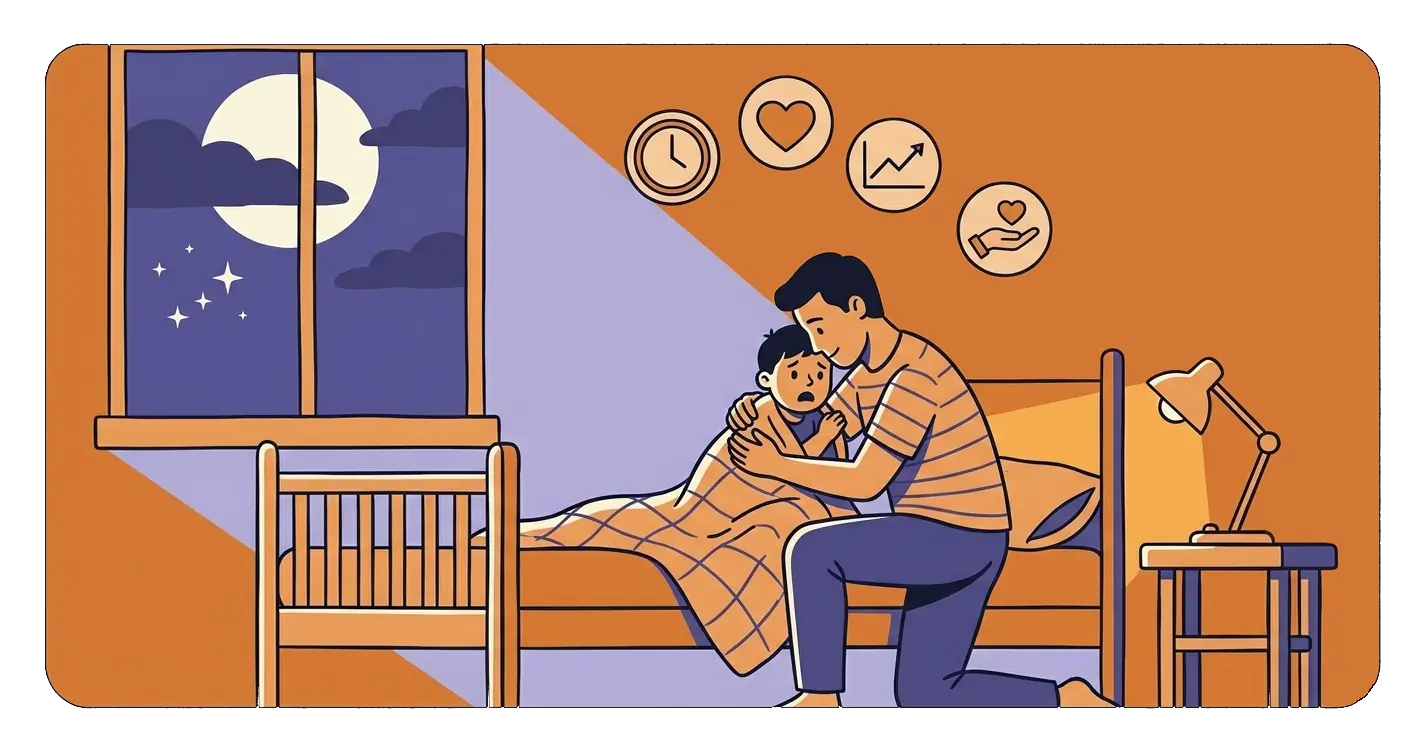
The fact that a child needs more closeness during a difficult period is very human and very common 🤍 There's no need to pretend nothing is happening. At the same time, from our experience, the best approach is: more support, yes, but without turning everything upside down.
You can be closer, speak more calmly, stay a little longer at bedtime, and respond faster to night wakings. However, it's good for the core of the evening to remain familiar: similar sequence of actions, the same sleep place, similar pace.
The following usually help: - short, calm contact after waking, - stroking, hugging, helping to reposition, - a few extra minutes of presence at bedtime, - dimmed lights and a calmer evening, - more support for a few days or 1–2 weeks, then a gradual return to the previous rhythm.
In practice, we see that the biggest problem starts when one difficult night becomes a new normal. If the child didn't previously fall asleep only in arms, it's not worth immediately making it a permanent method. The same goes for long rocking or providing a lot of help at every waking.
A Simple Plan for a Tougher Night
When the night falls apart, it's good to have a simple scheme: 1. first give a moment to calm down — approach calmly, speak softly, 2. then add a little help — stroke, hug, adjust position, 3. leave stronger support for last — pick up, feed, or stay longer if really needed.
This approach usually gives parents the feeling that they're supporting the child but not accidentally creating new difficulties for the coming weeks.
Overstimulation — The Silent Culprit of a Difficult Evening
In practice, very often the problem isn't the leap itself, but what's happening around it. A child in an intense developmental stage gets overwhelmed faster. Everything seems normal, but by the end of the day, the child is so 'full' of impressions that they can't wind down calmly 😵💫
This is especially noticeable in children who seem to get a second wind in the evening. They're sleepy but also more active, louder, more irritable. Parents often tell us: “He looks like he doesn't want to sleep at all,” and we see simply exhaustion and overstimulation.
What usually adds to the problems? - too intense an afternoon, - too quickly extending wake times, - abandoning routine, - several changes at once, - adding attractions when the child is already barely holding on.
What usually helps? - a calmer pace in the afternoon, - limiting noise, screens, and excess stimuli, - 15–30 minutes of calm winding down after intense play, - a simple, predictable evening, - starting to wind down earlier if the day was tough.
We remember a mom who was convinced the problem was just a sleep regression. When we broke down the whole day, it turned out that every late afternoon there was a family gathering, loud play, and lots of impressions. After a few calmer evenings, sleep didn't become perfect, but it was noticeably easier.
How to React Calmly and Not Go Crazy?
If we leave you with one most important thought, it's this: don't judge the situation after one night. From our experience, it's much better to look at 3–5 days, because only then do you see the real pattern. One bad night can simply be a tougher evening, not a signal that everything needs to change.
The best approach usually is: - maintaining a predictable routine, - a small adjustment to the plan instead of a revolution, - a bit more support before sleep and at night, - observing the whole day, not just night wakings, - patience for a few days before drawing bigger conclusions.
In our work with families, we really often see that even small changes bring relief within a few days. And if they don't, that's valuable information too — because then you know you need to look deeper.
Summary
A developmental leap can significantly disrupt sleep, but it usually doesn't mean that everything is permanently broken. Most often, we see sudden wakings, shorter naps, more resistance at bedtime, and a greater need for closeness. It can be exhausting, but very often it's temporary.
From our experience, the best approach is a calm one: first observation, then small adjustments, lots of predictability, and support tailored to what the child currently needs. Without rushing, without adding five changes at once, and without the pressure to 'fix' sleep in one evening.
If difficulties last longer than about 2 weeks, intensify, or you simply don't know if it's about development, the daily routine, or the method of falling asleep, we're happy to help you sort it out. You can check out our consultation form: /SleepAssessment