Child Only Falls Asleep in Your Arms? How to Gently Transition to the Crib
When You Put Your Child Down and Hear Crying Again
If you feel like the entire bedtime routine revolves around one thing: arms, breast, putting down, crying, and repeat — you're certainly not alone. In our work with families, this is one of the most common topics. Parents often tell us they're afraid to even sit down in the evening, knowing that as soon as they lay their little one down, sleep will end in a few minutes. 😮💨
From our experience, this doesn't necessarily mean you've "spoiled" your child. We often see a little one who calms best when close to a parent's body. Warmth, movement, sucking, familiar scent — for many children, this is the simplest path to sleep, especially at the beginning of life.
In practice, we also observe that parents quickly start to feel trapped. One hand occupied, the evening disappears, and the question arises: "Can this change without a big battle?" The good news is that it usually can — but it's best done calmly, in stages, and with a realistic plan. 🤍
In this article, we'll show you why falling asleep only in arms or while nursing happens, when it's worth starting a change, and how to transition to the crib without turning everything upside down.
Why Falling Asleep Only in Arms or While Nursing Happens
From our experience, with the youngest children, this is often not a "problem to fix," but rather everyday life. A small infant doesn't yet know how to slow down like an older child. When they're close to you, their body simply calms down more easily.
In practice, we see this especially often in the first months. A child falls asleep beautifully in arms, but once placed in the crib, they immediately feel the change: different temperature, no movement, no scent of you so close. For us, it's a bit like being moved from a warm couch to a cooler sheet — only an infant reacts much more strongly.
Parents often ask if this means the child has "learned" to sleep only one way. Sometimes that's the case, especially later. But very often, especially at the beginning, we simply see a great need for regulation and closeness, not a bad habit.
From our practice: many families only calm down when they hear that it's not necessary to immediately strive for full independence. For a newborn or younger infant, the goal is usually not "fall asleep alone," but rather "fall asleep more calmly and sometimes be put down."
When It Sounds Like a Phase and When It's Worth Pausing
We usually look at the situation more calmly when the child:
- eats well,
- gains weight,
- calms down when cuddled or sucking,
- doesn't seem in pain,
- functions relatively normally outside of sleep.
However, if everything suddenly changes drastically, we look more broadly. In practice, we see that sometimes more difficult falling asleep is not due to the method of putting to sleep, but discomfort — for example, a stuffy nose, worse breathing when lying down, or general irritability.
How to Distinguish a Developmental Phase from Something That Truly Hinders Sleep
Parents often tell us: "If only we knew if it would pass on its own." And that's a very valid question. From our experience, a developmental phase usually looks like this: for a few days or a dozen days, the child is more "on you" than usual — wants to be carried more often, wakes up more quickly, and has a harder time letting go in the evening.
In practice, such a time often comes in waves. First, evenings become more difficult, then shorter naps or more frequent awakenings occur, and after some time, the situation calms down again. For many families, such a rough period lasts from a few days to about 1–3 weeks.
On the other hand, there are moments when it's worth not immediately focusing on "crib training," but first checking if something physically bothers the child. Especially if you see that the protest is stronger than usual or the little one poorly tolerates the lying position.
From our experience, warning signs are usually:
- clearly worse breathing when lying flat,
- a stuffy nose,
- difficulty calming down even in arms,
- crying that sounds different than usual,
- worsening feeding and sleep simultaneously.
In our work with families, we often repeat a simple filter: is the problem mainly about falling asleep, or the child's overall functioning? If not only sleep but also eating and daily comfort fall apart, it's worth looking at it more broadly first.
When It's a Good Time for Change
Not every week is a good time to introduce new things. From our experience, it's best to start when the situation is at least somewhat stable. It doesn't have to be perfect — it's enough that the child isn't sick, doesn't have clear discomfort, and you have a bit of space to act calmly for a few consecutive days.
In practice, changes made "on the brink of endurance" usually turn out the worst, when the parent is already so tired that they try something different every day. Sometimes they carry longer, sometimes they put down faster, sometimes they return to nursing to full sleep. This is very human, but for the child, it can be simply unclear.
From our practice: we often see improvement only when the family chooses one small step and sticks to it for a few days. Not a spectacular plan, but something simple and repeatable.
Better to Wait If Something from This List Is Happening Now
It's worth postponing a major change if there is:
- an infection,
- a low-grade fever or fever,
- a clearly stuffy nose,
- difficulty breathing when lying down,
- sudden and significant worsening of sleep,
- very strong "clinginess" to the parent all day. 😴
If none of this is present, and you feel like you want to organize something, it's usually a good time to start with small attempts.
How to Transition from Arms to Crib Without a Sudden Revolution
From our experience, the best approach is to think: we don't take away all the help at once, but reduce it piece by piece. This is important because a child who has always fallen asleep in motion and close to a body won't switch overnight to a completely new way of falling asleep.
In practice, a simple ladder works well:
- first arms and rocking,
- then arms but with less movement,
- later arms without rocking,
- then putting down a very sleepy child,
- finally, more support already at the crib.
This is not a race. For some families, one stage lasts 2–4 days, for others a week. If the child is very young, we think more about familiarizing them with the crib than about a complete change in the way of falling asleep.
How It Looks in Practice
At the start, it's worth simply rocking a little more gently than usual. It's not about stopping right away, but about making the movement smaller. Then you can pause a bit earlier and hold the child calmly, without rocking.
When this stage becomes relatively acceptable, try putting the little one down when they're sleepy but not "out." This is a moment that can't be calculated to the minute — usually, you just have to feel it through a few attempts.
After putting down, stay close. In practice, it often helps to:
- place a hand on the chest or belly,
- use a soft voice,
- spend a few calm seconds without rushing,
- then possibly return to holding.
From our practice: if the child protests strongly, it's usually better to take half a step back rather than give up everything. This makes a big psychological difference for the parent as well.
What Really Helps and What Is Easy to Forget
Sometimes parents focus solely on the act of putting down, but we see in practice that the basics of the day are hugely important. It's much easier for a child to accept change if they're not extremely overtired and receive similar signals before sleep.
Most often, it helps to have:
- a relatively consistent daily rhythm,
- sensibly timed naps,
- one main sleep location,
- a short, similar bedtime routine,
- calmer lighting and fewer stimuli in the evening. 🌙
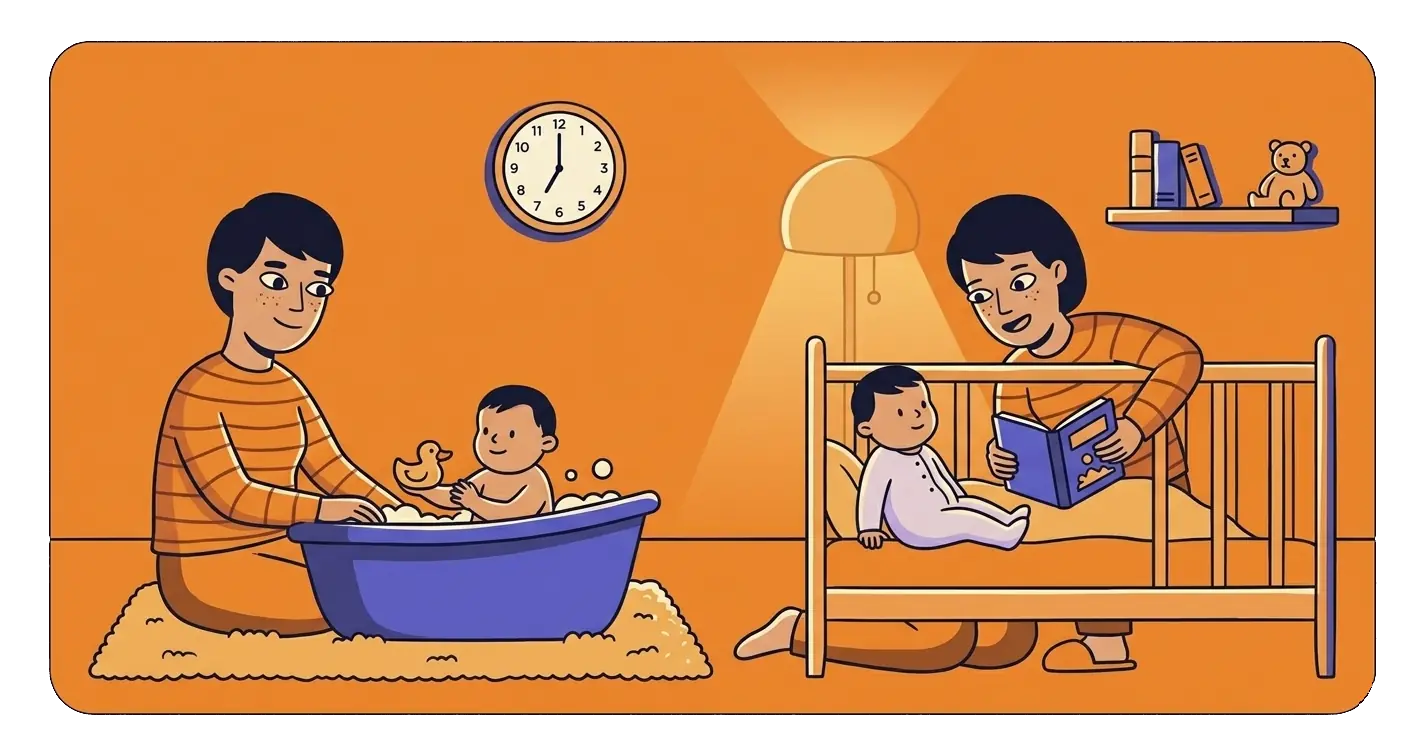
This doesn't have to be a perfectly detailed plan. In our work with families, a really simple scheme often suffices: changing, dimming the lights, feeding, a moment of calming, sleep. The child then begins to associate that rest is approaching.
When an Infant Only Falls Asleep While Nursing
This is a topic that comes up very often. From our experience, the breast at bedtime is not only a way for many children to eat but also to calm their entire body. That's why suddenly cutting off this element usually results in a lot of tension.
In practice, gently separating feeding from the actual moment of falling asleep works better. So we don't take away what the child knows, but slowly move feeding earlier, and at the very end, add other forms of calming.
How to Do This Calmly
You can start like this:
- for 2–3 days, finish feeding just before full sleep,
- then for the next few days, add short cuddling or carrying after feeding,
- then extend this stage to a few minutes,
- finally, introduce a consistent mini-ritual after feeding: burping, cuddling, white noise, putting down.
From our practice: parents often feel that if the child protested on the first evening, the plan isn't working. But we very often see that after 3–5 days, the tension starts to decrease because the little one understands the new order.
If the child is very young and still needs the breast to calm down, that's okay too. Sometimes we first work only on ensuring that not every awakening ends exactly the same, and only later on the actual falling asleep.
How to Put Down to Reduce the Risk of Waking
The act of putting down really matters. In practice, we observe that many children are awakened not so much by the crib itself, but by too sudden a change: from warm arms to a still mattress.
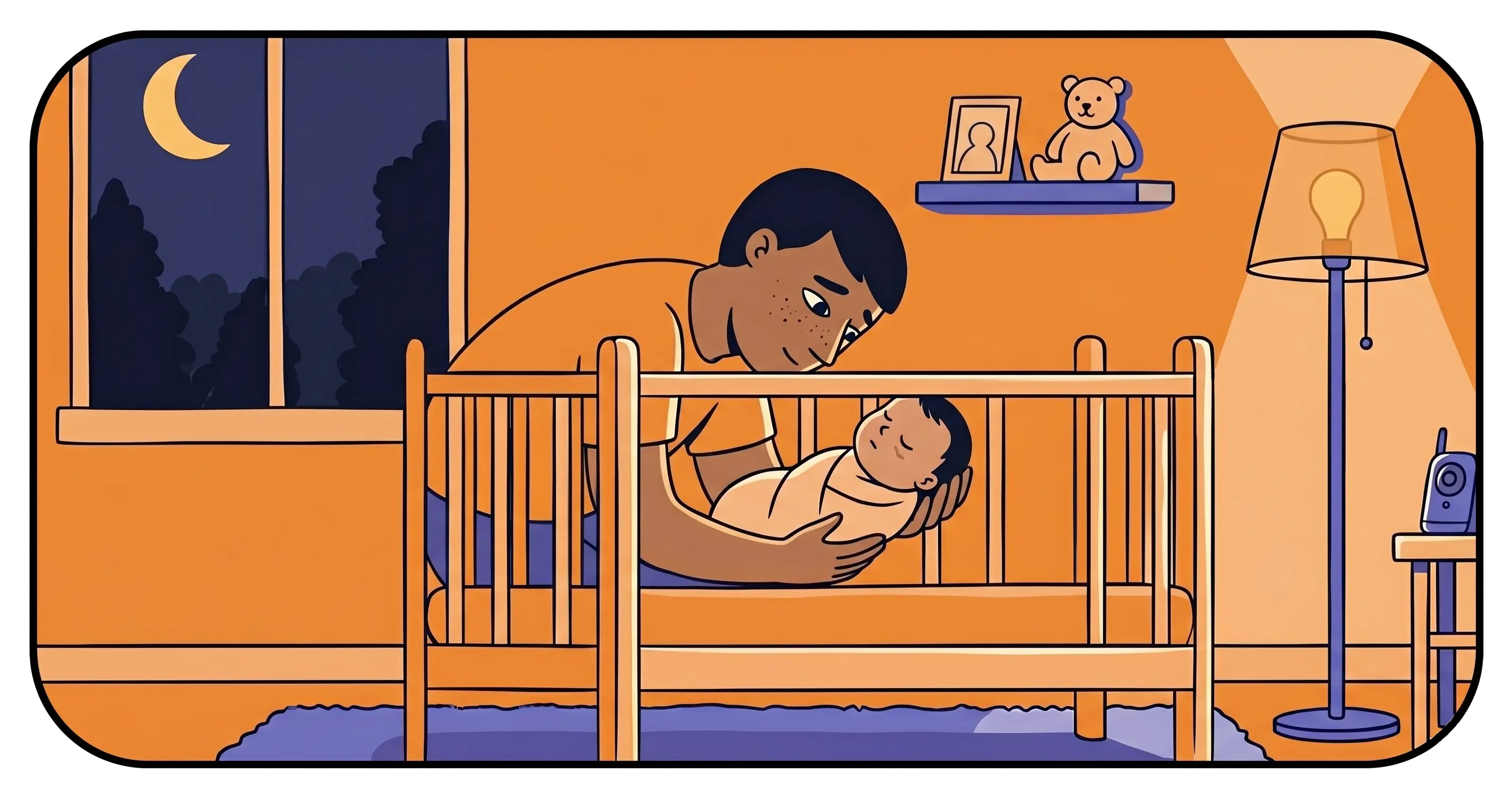
That's why we usually recommend putting down slowly and very smoothly. Keep the child close to you until the last moment, instead of "transferring" them from a distance. Most often, it's gentler to put down the bottom first, then the back, and finally the head.
After putting down, don't disappear immediately. Stay a moment longer with the child, place your hand calmly on their body or rest it nearby. For many families, it's these 20–60 seconds after putting down that make the biggest difference.
From our practice: we often see that the parent performs the act of putting down very gently, but then immediately withdraws their hands and leaves. For some children, it's this very moment that's the hardest.
Small Technical Tips
It's worth checking these details:
- is the room dimly lit,
- does the bedtime ritual look similar every day,
- are you not putting the child down too early,
- do you give them a moment to "complete" the transition to sleep after putting down.
These are small things, but in practice, they often add up to a bigger improvement.
Common Mistakes That Prolong the Whole Process
From our experience, the biggest problem is usually not that the child likes arms, but that the change is too chaotic. One day we try the crib, the next we return to long carrying, the third we change the bedtime. For an adult, these are minor adjustments, but for a child — a completely different evening map.
The second common issue is too high expectations. If a little one has been falling asleep in one specific way for weeks or months, it's hard to expect everything to look different after two evenings. In practice, the first effects are often small: shorter rocking, calmer putting down, less intense protest.
Sometimes we also see the opposite extreme — the parent reacts to every sound with immediate removal from the crib. Of course, it's not about leaving the child without support. But it's worth distinguishing between short fussing or fidgeting and a situation where the little one is really getting worked up.
The process is most often slowed down by:
- lack of one consistent plan for several days,
- starting the change during illness or a major sleep crisis,
- overtiredness before evening,
- changing several things at once,
- expecting improvement after 1–2 days.
Is Falling Asleep in Arms Spoiling?
In short: from our experience, no. Especially with the youngest children, closeness is not a whim, but a real need. A little one doesn't "make up" that they want to be carried — they simply regulate best near you.
What is worth distinguishing is the need and the method that no longer serves the family. You can simultaneously acknowledge that the child truly needs support and notice that the current bedtime model is already very burdensome for you.
In practice, that's when we start to change something. Not to take away closeness from the child, but to find a way of falling asleep that will also be gentler for you.
How to Know You're on the Right Track
Parents often look for a big breakthrough, but in practice, we encourage looking for smaller signals. The child may not suddenly start sleeping perfectly, but they might:
- fall asleep a little faster,
- need shorter rocking,
- react more calmly to being put down,
- return to sleep more easily after waking,
- protest less intensely during change.
These are really important signs of progress. From our experience, the first small effects often appear after 3–5 days, and more noticeable improvement after 2–3 weeks of calm consistency.
If after a dozen days you see that it's only getting harder, the child is increasingly tired, and evenings are falling apart even more, it's worth modifying the plan. Sometimes the pace is too fast. Sometimes the problem lies not in the falling asleep itself, but somewhere else.
Summary: Where to Start Today
If you want to get started, don't try to change everything at once. From our experience, the best approach is a simple start:
- choose one situation to practice,
- reduce help just a little,
- stick to the same plan for 4–7 days,
- observe the trend, not a single evening,
- stop if you see clear discomfort in the child.
In practice, it's the small steps that offer the greatest chance for a peaceful change. Not a perfect plan, not pressure, not a race — just consistency, patience, and adaptation to your child. 🤍
If you wish, we can help you create such a plan tailored to the age, temperament, and current situation of your family. Check out our SleepComplainer consultation form — describe what your sleep looks like, and we'll suggest where to start.