Baby Sleep Chart: How Much Should Your Baby Sleep? A Guide
Is Your Baby Sleeping Too Little?
Parents often write to us with one thought in mind: “I look at the chart and feel like my baby doesn't fit in it.” And honestly? It happens quite often 💤. In practice, we see many babies sleep a bit differently than the “textbook” suggests, yet they function perfectly well.
Initially, the most stressful part is that a baby's sleep is simply inconsistent. One day naps are quite decent, and the next everything falls apart. From our experience, this is more of a daily occurrence than an exception in the first year.
So, we wouldn't start by asking: “Does the number of hours match?” It's better to ask: how does your baby feel during the day, how do they fall asleep, and how do they react in the evening. This usually provides much more insight than just the chart.
If your little one regularly: - is more tearful than usual, - finds it hard to calm down, - demands constant holding, - yawns often, rubs their eyes, or “zones out” with their gaze, - suddenly becomes very stimulated in the evening,
then it's worth taking a closer look at the daily rhythm.
In this article, we'll show you how to use the sleep chart without stress, when it's really worth making improvements, and what to do if your baby just has their own sleeping style.
Baby Sleep Chart by Age
From our experience, the sleep chart works best when you treat it as a reference point, not a judgment of parental competence 🙂. It's meant to help you get oriented, but there's no point in forcing your child to fit one number.
Indicative Sleep Ranges
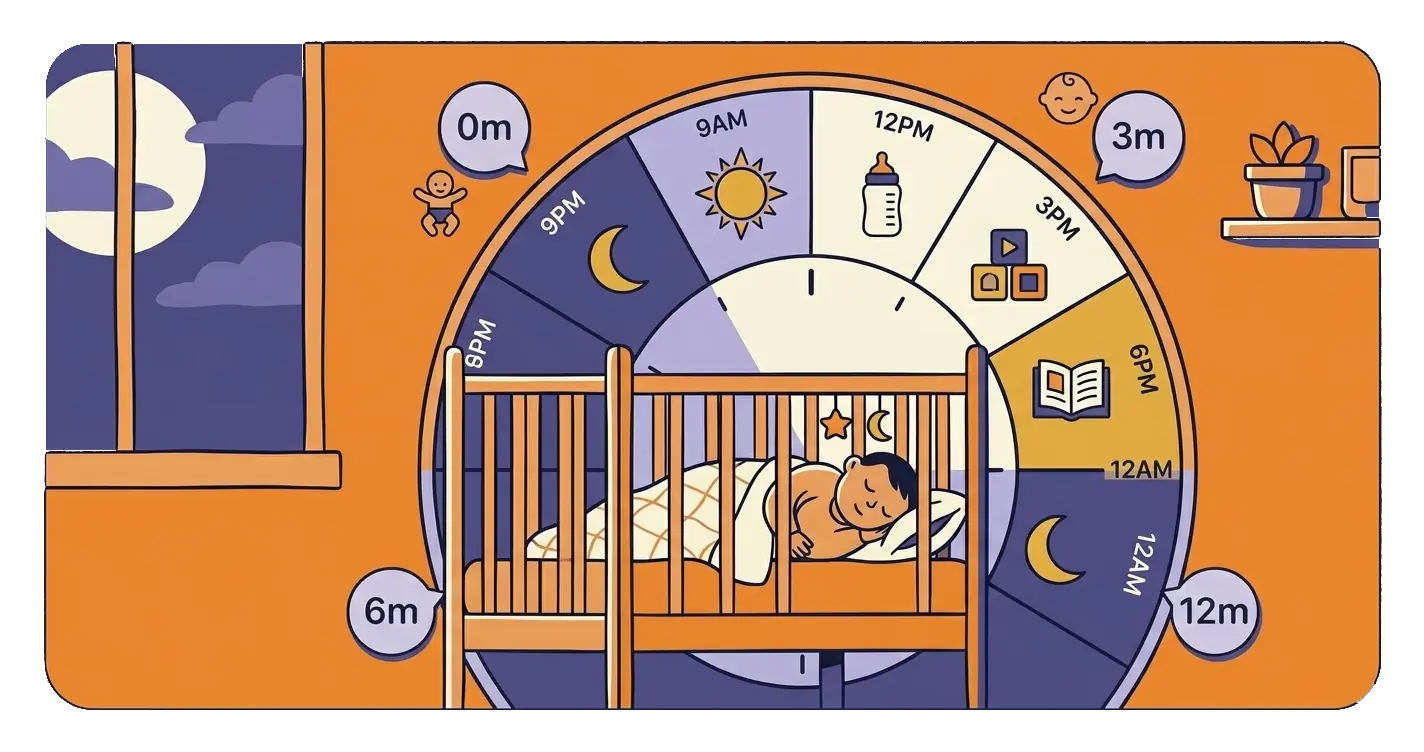
| Child's Age | Night Sleep | Daytime Naps | Total per Day |
|---|---|---|---|
| 0–3 months | 8–10 hours | 4–6 | 14–17 hours |
| 4–6 months | 10–12 hours | 3–4 | 13–16 hours |
| 7–12 months | 10.5–12 hours | 2–3 | 12–15 hours |
These are indicative ranges, not rigid norms. In our work with families, we see children who sleep a bit less but are cheerful and fall asleep well. We also see those who need a bit more sleep to truly “find their balance.”
How to Read the Chart in Practice
In the first weeks of life, little falls into place. A baby sleeps in bits, wakes up at various times, and it's hard to talk about a predictable daily schedule. That's why with the youngest children, we mainly look at the total sleep over 24 hours, not whether the night already looks “nice.”
Between 4 and 6 months, things usually start to become a bit clearer. One child may already have 3 naps, while another still has 4, and both situations can be perfectly fine. In practice, we observe that this stage is often transitional and requires more flexibility than perfect planning.
In the second half of the first year, the day often begins to have a more predictable rhythm. But even then, transitioning from 3 naps to 2 rarely happens “from Monday.” Usually, for a week or two, everything is a bit in between — and that's normal.
When the Child is More Important Than Numbers
What's written in the chart can be helpful. But what you see daily in your child is simply more important 👶. If your baby supposedly “meets the hours,” yet ends each day irritable, it's a sign to look more broadly.
We often pay attention to situations like: - the child gets frustrated quickly, - cries more often without a clear reason, - has trouble settling into a nap, - is visibly overwhelmed in the evening, - falling asleep becomes a struggle.
From our experience, sometimes the problem isn't the amount of sleep but the timing of sleep. Two naps may “match,” but if they're poorly timed, the evening and night can fall apart significantly.
What to Do When Your Child Doesn't Fit the Chart
Instead of immediately rearranging the entire day, it's worth first checking what the sleep really looks like. Not “by eye,” not from memory after a tough night, but specifically. It's best to record for 3–5 days: - the time of morning wake-up, - the length of each nap, - the time of falling asleep at night, - the mood after waking and in the evening.
This simple step often makes a big difference. In our work with families, we often see that a parent feels chaos, but after recording a few days, a fairly clear pattern emerges. And then it's easier to decide whether to change something or rather let go of the pressure.
We remember a mother of a 5-month-old boy who was sure her son “hardly sleeps.” After 4 days of notes, it turned out that the total amount of sleep was quite alright, and the biggest issue was putting him to bed too late at night. After a slight shift in the evening, the situation began to calm down within a few days.
How Baby Sleep Changes in the First Year
The first months are usually a rollercoaster. A baby can sleep a lot of hours in a day, but in very short segments and at unpredictable times. In practice, this means that day and night can still mix for a long time 🌙
Around the 3rd month, some babies start to show more repetition. It's not about an ideal schedule right away, but rather that certain times of the day start to look similar. If the morning falls into a similar pattern for a few days, it's a good signal to gently support the daily rhythm.
Often helps: - morning light and regular activity after waking, - a calmer evening, - a short, repetitive bedtime ritual.
Around the 4th month, many parents feel that sleep suddenly worsened. The baby wakes more often, is harder to settle into the crib, and clearly needs closeness. From our experience, this stage can last from a few days to 2–3 weeks, and usually, calmness and sticking to simple, predictable routines work best.
In the following months, the night may become longer, and naps gradually fewer. It usually looks like a smooth transition from 4 to 3, and then from 3 to 2 naps. Some children do this smoothly, others hang between one setup and another for a while.
Sleep Norms vs. Individual Child Needs
Parents often ask us directly: “So how do I know if everything is okay?”. Simply put: we look at the whole child, not just the number of hours. Because a baby can sleep a bit less than average and still be doing well.
In practice, it looks good when the child: - wakes up relatively calmly, - has an appetite, - has moments of contact and interest in the surroundings, - usually falls asleep without a long struggle, - is not constantly irritable throughout the day.
There's also the opposite situation. On paper, everything looks fine, but the baby is clearly overtired. Then it's usually not about a “bad sleep character,” but that the daily rhythm isn't well adjusted yet.
If such a picture persists for several days in a row, it's worth making one small adjustment. We often recommend putting the child to bed 10–20 minutes earlier and seeing over 3–5 days if falling asleep becomes easier.
How to Tell If Your Baby Is Sleeping Too Little
It doesn't always look like a parent imagines. Sometimes the child doesn't look “sleepy,” but rather irritable, tense, or overly stimulated. And that's often one of the more common signs of overtiredness.
We most often see: - fussiness and tearfulness without an obvious reason, - difficulty calming down even when held, - a strong need for holding and closeness, - sudden shifts from a good mood to frustration.
There are also more subtle signals: - yawning, - rubbing eyes, - heavy eyelids, - turning away gaze, - arching the body, - clenching fists.
In practice, we observe that these signs often appear just before falling asleep becomes much more difficult. If you react earlier, it's usually easier to “catch” the right moment for sleep.
Not Every Tiredness Looks Calm
In older infants, tiredness often looks quite the opposite of sleepiness. The child becomes louder, more active, as if they suddenly got new energy 😵💫. Parents often think then: “Oh, they still don't want to sleep,” but in practice, we very often see that it's already overtiredness.
We once had an 8-month-old girl in consultation who “came alive” every evening around 8:00 PM. Her parents were convinced that it was her natural activity time. After shifting her nighttime sleep a bit earlier, it turned out that the evening stimulation was simply a signal that she was ending the day too late.
Too Little Sleep or Poorly Timed Periods?
This is an important distinction. If a child sleeps little overall for several days, the problem is usually a lack of sleep. If the total hours are fine, but there are tears before naps and difficult evenings, it's more often about mistimed bedtime.
What to do for a few days: 1. record sleep and wake times, 2. note the first signs of tiredness, 3. try putting the child to bed 10–15 minutes earlier.
Very often, after 3–5 days, you can see which way it's going.
How to Arrange a Baby's Daily Schedule
Parents often ask us if it's even possible to have any daily plan with a baby. Our answer is: yes, but not to the minute. The best results come from frameworks that organize the day but don't rigidly enforce it 🕒
We usually start with two simple points: - a relatively similar morning wake-up time, - a repeatable bedtime.
This is really enough as a base. The rest of the day can still shift slightly depending on naps, feeding, or a bad day. In practice, this flexible predictability gives parents the most relief.
If your child naturally wakes around 7:30 and functions well, there's no point in shifting them to 6:00 just because that's what someone's plan from the internet looked like. The same goes for the evening — for one baby, 7:00 PM will be good, for another closer to 8:00 PM.
Where to Start
In the first weeks of life, we don't expect regularity like clockwork. Most often, the day simply looks like this: feeding, a moment of contact, sleep. And that's really enough.
In our work with families, the best results come from combining observing the child with loose daily frameworks. The clock can guide, but it shouldn't drown out what you see in your baby.
Indicative Wake Windows
To start, you can treat these ranges as a guide: - 0–6 weeks: about 45–60 minutes, - 2–3 months: about 60–90 minutes, - later, wakefulness usually gradually lengthens.
If the child starts yawning, turning away their gaze, rubbing their eyes, or suddenly becomes “hyped up,” it's worth not waiting for the perfect hour. In practice, responding to the child works better than sticking rigidly to a plan 😴
How to Adapt the Plan to You
The simplest way: 1. For 3–5 days, record wake-ups, naps, and evening sleep. 2. Check after how much wake time the child falls asleep most easily. 3. Build the plan around these repeatable moments.
From our experience, the first organization of the day is often visible after a few days, and greater predictability after 1–2 weeks.
Common Mistakes and How to Fix Them
One of the most common traps is extending the evening in hopes that a more tired child will sleep longer. In practice, the opposite usually happens. Falling asleep is harder, the night more fragmented, and the morning can start surprisingly early.
The second common mistake is ignoring the first signs of tiredness. It's easy to think: “They'll hold on a bit longer.” The problem is that in infants, this “bit” can be very short and quickly ends in overtiredness.
We also see that nights worsen when the day is very random. Once a long last nap, once a very late evening, once a completely different wake-up. Even simple daily frameworks can make a big difference for older infants.
How to Correct It
- Shift the night earlier by 15–20 minutes, not an hour at once.
- Keep a similar morning wake-up time within 20–30 minutes.
- Watch for signs of tiredness, not just the clock.
- Don't change everything at once.
- Give yourself 5–10 days for the first effects and about 2–3 weeks for greater rhythm calming.
What Most Often Disrupts Baby Sleep
Not every difficult sleep means you're doing something wrong. In practice, we very often see that sleep deteriorates simply because the child is in a more demanding stage. Therefore, a single weaker night or even a few bad days doesn't determine anything yet.
Teething 🦷
Evenings often bring more anxiety, fussiness, and a need for closeness. Some children wake more often, put their hands in their mouths, and have trouble calming down.
What can help: - a cooled teether before sleep, - gentle gum massage, - a calmer evening without excess stimuli.
If you feel it's not just discomfort but clear pain, it's worth contacting a pediatrician. Improvement during teething often comes in waves.
Intense Development
There are periods when a child suddenly wakes more often, finds it harder to fall asleep, and clearly needs a parent. In our work with families, this is a very common picture during major developmental changes.
This stage usually lasts from a few days to 2–3 weeks. Simplicity usually helps: a calm evening, a consistent ritual, and as little nervous testing of new solutions as possible.
Illness, Food, and Overstimulation 🌙
Sleep can also be disrupted by: - infection, - runny nose, - fever, - discomfort after eating, - more frequent night feedings, - too intense an evening, - screens before sleep.
In such moments, usually, more gentleness and a bit less expectation work best. But at the same time, it's worth leaving a few fixed points in the day to avoid falling into complete chaos.
When to Consult Sleep with a Pediatrician or Specialist
Parents often ask us when to keep observing and when not to wait. From our experience, it's worth reacting sooner if, besides difficult sleep, there are also health signals 🩺
Pay special attention to breathing during sleep. If your child: - regularly snores, - has breathing pauses, - often coughs at night, - wakes up as if they lack air,
it's not worth delaying. It's best to schedule a consultation with a pediatrician in the coming days.
It's also worth consulting if there are symptoms related to feeding and digestion: - frequent spitting up, - reflux, - sour breath, - arching the body backward, - anxiety during feeding, - refusing to eat.
Additionally, there are stomach pains, clear discomfort after eating, or intensified skin problems with itching. If despite a calmer daily plan, sleep remains difficult for 1–2 weeks, and you see such symptoms, it's first worth checking the health side.
Summary: How to Use the Sleep Chart Without Pressure
If after reading you still think: “Okay, but how much exactly should my child sleep?” — we want to tell you one thing: the chart is meant to help, not stress. The most important thing is how your child functions, not whether they fit perfectly within the ranges.
In practice, 4 things work best: - adjusting sleep to age and signs of tiredness, - not too late an evening, - repetition without rigidity, - small adjustments instead of revolutions.
Simple Action Plan
Today: - calmly look at the last 24 hours of sleep, - notice when the first signs of tiredness appear, - choose one small change, like an earlier bedtime by 10–15 minutes.
For 3 days: - record wake-ups, naps, and evening sleep, - note the child's mood after waking and in the evening, - check if falling asleep becomes easier.
For 2 weeks: - maintain fairly stable daily frameworks, - don't introduce multiple changes at once, - observe if sleep becomes calmer and more predictable.
From our experience, the first small effects are often visible after 3–7 days, and clearer sleep organization after 2–3 weeks. If you like, we can help you look at your situation individually — check out our consultation form.