Meal Plan for a One-Year-Old: What Can Your Toddler Eat Daily and How Many Meals to Serve?
Your Toddler at the Table and a Million Questions in Your Mind
Parents often write to us with a similar dilemma: should a child eat the same as the family after their first birthday, or do they still need separate meals? Honestly, this is a time when many families feel a bit lost. Suddenly, questions arise about portions, meal times, chewing, safety, and whether it's "time" for the family table 🙂
From our experience, after the 12th month, you don't need a kitchen revolution. Usually, it's enough to simplify family meals and adapt them to the child's abilities. In practice, toddlers usually do well with simple meals: soft, mild, easy to chew, and served without rush.
For many families, the greatest relief comes not from a perfect meal plan, but from a consistent daily rhythm. When a child roughly knows when breakfast, lunch, and dinner are, it's easier for them to come to the table with an appetite. We often see that just a few calmer days can make a big difference.
In this article, we'll show you in simple terms, what usually works for a toddler daily, how to space out meals, and how to avoid the trap of constantly wondering if your child has eaten "enough."
How Many Meals Typically Work for a Toddler
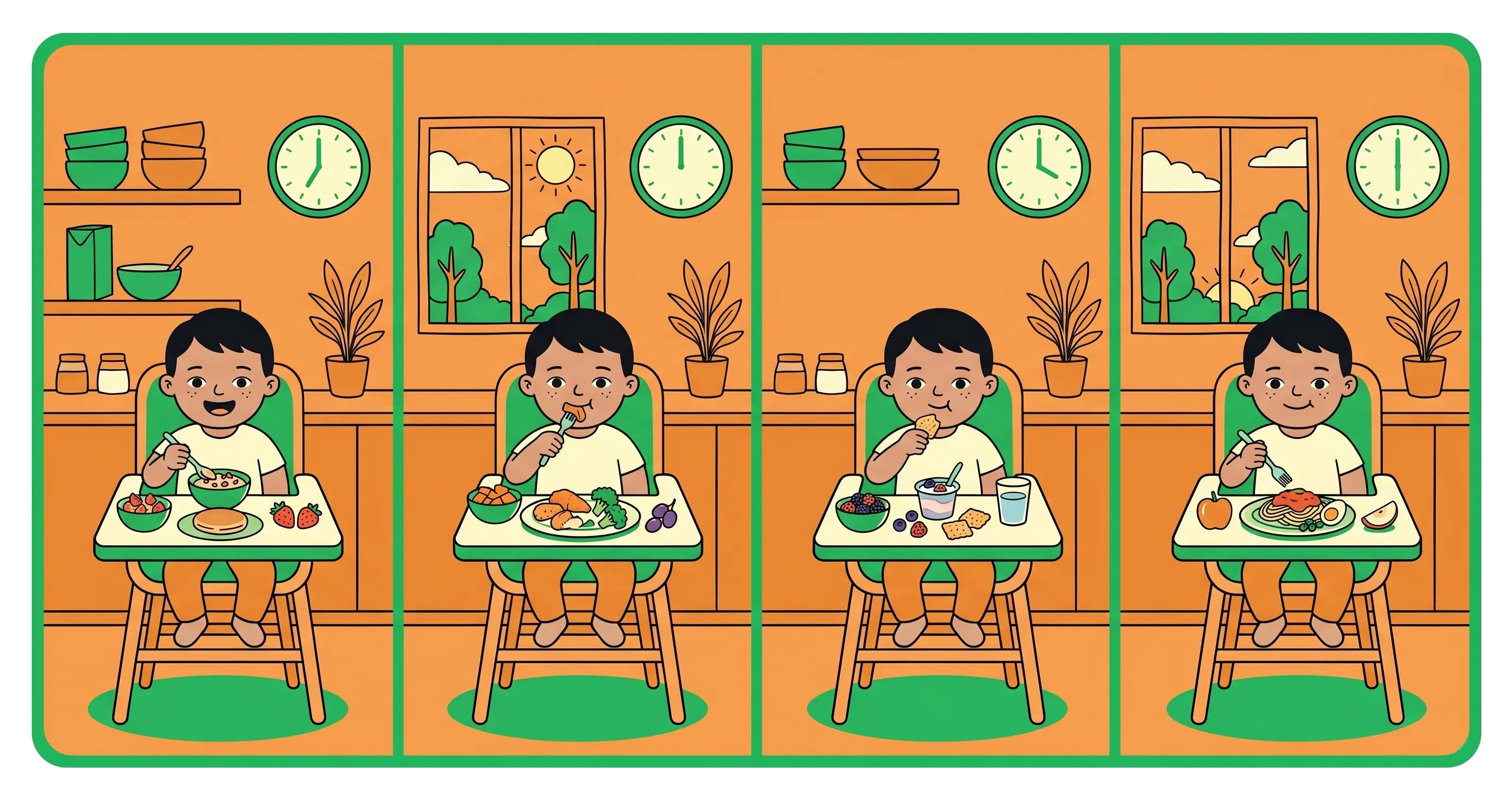
In practice, a schedule of 3 larger meals and 1–2 smaller ones usually works well. Typically: breakfast, lunch, dinner, and additionally a second breakfast and either an afternoon snack or a small treat. This plan is easy to manage and doesn't overwhelm the child with food all day.
From our experience, breaks of about 3–4 hours work best. This gives the child time to get hungry, and meals don't blend into one long snack. In practice, it's the constant "just a piece" that often spoils the appetite more than anything else.
An example daily rhythm might look like this:
- 7:00–8:00 – breakfast
- 10:00–10:30 – second breakfast
- 13:00–14:00 – lunch
- 16:00–16:30 – afternoon snack
- 18:30–19:30 – dinner
In our work with families, we also see that not every child is like clockwork. One likes fixed hours, another eats more "in waves" during teething or nap changes. That's why we usually tell parents: regularity yes, rigidity no 🍽️
If lunch is later one day or the child eats less, it doesn't mean the whole plan is ruined. Just return to the next meal without making up with snacks or fruit "so they eat something." For many families, order at the table returns after a few days to about 2 weeks.
What a Toddler Can Eat Daily
Parents often look for a "allowed – not allowed" list, but in daily life, simpler thinking works better. From our experience, it's worth organizing the day so that vegetables, fruits, grains, something protein-rich, and a bit of fat appear. Not perfectly balanced in every meal, just normally, home-style.
In practice, a toddler doesn't need fancy dishes. Repetitive, simple meals that are easy to prepare again without fatigue work much better. Parents often sigh with relief when they hear from us that oatmeal, soup, sandwiches, meatballs, and soft vegetables are really a good enough direction 😊
Vegetables and Fruits Without Overthinking
On a daily basis, vegetables that are soft after cooking or baking usually work best. In our work, we often recommend products like:
- carrot
- pumpkin
- zucchini
- broccoli
- cauliflower
- potato
- sweet potato
- beetroot
- peas
- green beans
You can serve them in various ways: as soup, puree, a side dish, or soft pieces to hold. In practice, many children will eagerly eat soup one day and choose the same vegetables in pieces the next. This is normal and not something to stress over.
With fruits, the following usually work well:
- banana
- pear
- apple – grated, soft, or slightly stewed
- blueberries
- raspberries
- peach
- plum
- apricot
In practice, we see that fruits are easily accepted, so sometimes it's the vegetables that need more patience. For many children, serving vegetables not only at lunch but also at dinner or as a sandwich addition helps.
Grains, Protein, and Fats – How to Manage Simply
To make a meal more filling, it's good to add something grain-based, something protein-rich, and a bit of fat. You don't need to count this with a calculator in hand. A simple scheme that can be repeated in a regular kitchen is enough.
On a daily basis, the following usually work well:
Grain products: - oatmeal - millet - buckwheat - rice - pasta - bread - simple pancakes
Protein sources: - egg - natural yogurt - cottage cheese - soft meat, e.g., chicken or turkey - meatballs - well-mashed fish - legume pastes if the child tolerates them well
Fats: - avocado - olive oil - a small amount of butter - smooth nut or sesame pastes if already known - fat added to soup, grains, or vegetables
From our experience, parents find this thought very helpful: you don't have to invent five new dishes every day. Often, having a few breakfasts, 2–3 lunches, and a few simple dinners in rotation is enough. This usually brings more peace than an ambitious plan that no one has the energy to implement.
The Form of Serving Matters More Than You Think
In practice, not every toddler eats the same way. One child eats soft pieces with confidence, while another still does better with more moist and soft food. Both situations are within the norm.
We usually don't look at age "on paper" but at how the child actually manages at the table. If they hold larger pieces in their mouth for a long time, push them out with their tongue, or quickly get discouraged, it might be worth returning to an easier consistency for a few days. Then calmly try again.
In our work, we've had many families where the transition from mushy to pieces didn't happen overnight. Sometimes only after 1–2 weeks of calm attempts did the child suddenly "get it." This is a very common scenario and doesn't mean you're doing something wrong.
What to Avoid or Be Careful About in Form
After the first birthday, a child's menu becomes broader, but that doesn't mean everything is equally easy and safe. In practice, we exercise the greatest caution with products that are hard, slippery, round, or difficult to break down.
We are particularly cautious about:
- whole grapes – best cut lengthwise
- hard pieces of raw apple – better grated, thinly sliced, or stewed
- whole nuts – not given in this form
- raw hard carrot – safer cooked
- large solid pieces of cold cuts or sausages – if they appear, very finely chopped and cautiously
From our experience, not only the product but also the moment and conditions of eating matter. Even a soft meal can be more challenging if the child eats on the run, laughs with a full mouth, or walks around the house with food in hand. That's why it's really worth emphasizing calm sitting at the table with a toddler.
In practice, we also limit what quickly triggers a sweet tooth or disrupts hunger. These are most often:
- juices and sweet drinks
- sweet snacks
- flavored crisps and ready snacks
- constant snacking between meals
- highly processed products with long ingredient lists
We see this very often: a child who snacks constantly starts to sit less well for regular meals after a few days. Then the parent feels like "they don't eat anything," although in reality, something was constantly being eaten. After 1–2 weeks of organizing snacking, the appetite usually looks much better 🌿
How Much to Serve Without Going Crazy Over Portions
Parents often ask us if they need to weigh food and monitor every gram. From our experience – it's not worth it and usually doesn't help. With a toddler, it's much more sensible to look at the whole day and week rather than how much was eaten from one bowl.
In practice, approximate, home-style portions work best. Not "82 grams of vegetables," but a few tablespoons, half a small bowl, a few pieces to hold. It's more practical and less stressful.
You can use this as a simple guide:
- vegetables several times a day
- at one time, e.g., 2–4 tablespoons, half a small bowl of soup, or a few soft pieces
- fruits usually 1–2 times a day
- e.g., a few pieces of banana, half a small pear, a few blueberries, or some grated apple
In our work with families, we see that the greatest peace comes when the parent stops "perfecting" every meal. One day the child eats more soup, another day more oatmeal, and yet another almost nothing for dinner. If the diet is fairly varied over the week, that's usually enough.
We've also had many moms and dads who noticed that the more they encouraged "just three more spoonfuls," the worse the eating went. When the pressure disappeared, after a few days or 1–2 weeks, the child started eating more calmly. This is one of those moments that often makes a big difference 🥦
How to Transition to a Family Table Without Cooking Two Dinners
This is one of the most common questions we hear: do I now have to cook separately for the child and separately for the rest of the family? Fortunately, most often, no. In practice, you can usually transition to shared meals gradually, without a big change overnight.
From our experience, this transition usually takes from 2 to 6 weeks. For some families, it goes quickly, for others more slowly, especially if the child is just getting used to pieces or if home meals are heavily seasoned. And that's okay.
Where to Start
The best rule is: the same dish, but the child's portion in a simpler version. So before you season the meal for adults, set aside a portion for the little one. Then, if necessary, mash, crush, or serve in a softer form.
At the start, dishes like these are easiest:
- vegetable soups
- soft meatballs
- baked or cooked vegetables
- rice, grains, potatoes
- mild sauces without heavy seasoning
In practice, many families start with a shared lunch because it's the simplest. Breakfasts and dinners often remain more "childish" for a while, and that's completely normal too.
How to Simplify a Family Dinner
The simplest trick that really works is: first the child's portion, then seasoning the rest. This way, you don't have to cook two separate dishes. Just one base and a small adjustment.
Examples that work well include:
- vegetable soup with soft vegetables
- meatballs with potatoes and vegetables
- pasta with a mild vegetable sauce
- turkey or chicken with rice and cooked sides
In our work with families, we often see that the biggest obstacle isn't the cooking itself, but the belief that the child needs a "special menu." Usually, they just need normal food in a mild and safe version.
Sample Meal Plan for a Toddler on a Typical Day
Parents often tell us: "Okay, theory is theory, but what should I give tomorrow morning?" And that's a very good question. Because a meal plan for a toddler should be primarily doable, not just pretty on paper.
1 Day – A Simple Example
A day like this usually works well in a regular home routine:
- Breakfast: oatmeal with grated apple
- Second breakfast: sandwich with cottage cheese and soft cucumber, plus pear pieces
- Lunch: vegetable soup + poultry meatball and cooked broccoli
- Afternoon snack: natural yogurt with mashed banana
- Dinner: millet with apricot or plum
For drinks, it's best to offer mainly water.
3 Days of Inspiration for Rotation
From our experience, it's much easier to plan meals when you don't create seven perfect days, but have a few proven options to mix.
Day 1 - breakfast: porridge with banana
- second breakfast: bread with egg paste and cucumber
- lunch: meatballs, rice, carrot with peas
- afternoon snack: yogurt with raspberries
- dinner: sandwich with avocado paste
Day 2 - breakfast: millet with pear
- second breakfast: stewed apple and a piece of bread
- lunch: pumpkin cream, turkey, potato, green beans
- afternoon snack: soft peach
- dinner: oatmeal with blueberries
Day 3 - breakfast: porridge with apricot
- second breakfast: sandwich with cottage cheese
- lunch: pasta with vegetable sauce and soft zucchini, plus beetroot
- afternoon snack: banana or plum
- dinner: vegetable paste with bread
In practice, mixing forms works best: sometimes soup, sometimes pieces, sometimes porridge, sometimes a sandwich. This way, the child practices different skills, and you don't feel like you're doing exactly the same thing every day.
Common Pitfalls in a Toddler's Diet
In our work with families, we rarely see the problem of "the child eats dramatically too little." Much more often, there's monotony, too much dairy, snacking, and eating "on the go." Then the parent feels like the child doesn't want anything, but in reality, they're already full of small bites.
We most often see situations like:
- too much dairy and too few other products
- constant snacking
- juices instead of fruits
- very little rotation of vegetables and forms of serving
- sweet snacks given "so they eat something"
How to improve this? Best to do it calmly, in small steps. In practice, introducing one change at a time works well. For example, first organize meal times, then add a new vegetable.
We often suggest a simple move to parents: place a tiny portion of something new next to a known product and don't push. The child doesn't have to eat it right away. Sometimes they just touch it first, then smell it, after a few days lick it, and only after 2–3 weeks eat a few bites. From our experience, this is how many successful menu expansions look.
We also remember a boy who for a long time accepted vegetables only in soup. Parents were convinced that pieces "wouldn't work." We started with one soft sweet potato stick next to lunch, and after about 10 days, he stopped rejecting it. Such small steps really count.
How to Know Everything Is Going in the Right Direction
Parents often ask us: how do I know this meal plan is okay if one day the child eats half a bowl, and the next three bites? And that's a very valid question. With a toddler, we look more broadly than at one meal.
From our experience, a good sign is that the child has energy, is developing, playing, learning new things, and eats somewhat varied over the week. They don't have to eat model meals every day. Very few one-year-olds operate this way.
What to pay attention to daily:
- does the child urinate regularly
- do they have energy to play
- is the diet not based solely on milk, bread, or fruits
- do they return to eating despite bad days
- is the range of products slowly expanding
In practice, we often observe that a toddler's appetite fluctuates. One day they eat little, the next more. This usually fits within the norm if everything progresses in the long run.
When to Seek Support
Don't wait for a consultation if you see:
- lack of weight gain
- significant drop on growth charts
- very few accepted products
- long-term tension at every meal
- frequent choking
- strong fear of eating or noticeable difficulties with chewing
In such situations, it's good to look at this calmly and specifically, rather than acting blindly.
Summary: How to Arrange a Toddler's Meal Plan Without Stress
If after reading this text you think: "Okay, but I just want to know what to do daily", we leave you with the most important thought: for a toddler, the best approach is a simple, repeatable rhythm and ordinary food. Not perfection. Not a new menu every day. Not counting every spoonful.
In practice, it's worth sticking to a few basics:
- serve 3 main meals and 1–2 smaller ones
- keep roughly 3–4 hour breaks
- focus on simple, minimally processed products
- ensure a soft and safe form of serving
- look at the whole week, not one weaker day
- transition to the family table gradually
From our experience, it's the calm, predictability, and a few simple meals that make the biggest difference. If you want, we can help you create a meal plan tailored to your child's appetite, daily rhythm, and challenges — check out our consultation form.