How to Start BLW Without Stress? Safe and First Foods
At the Beginning: "What if it Turns Out to Be Too Difficult?"
Parents often start with one thought: "I'd like to try BLW, but I'm a bit scared." And we truly understand this. With a first child, even a soft piece of banana can stir more emotions than the entire previous milk-feeding stage. 🍌
From our experience, the greatest tension comes not from BLW itself, but from the expectations of how this start "should" look. The truth is much calmer: initially, the child usually looks, squeezes, smears, and drops more than actually eats. And that's not a failure, just a normal stage.
In practice, we see this all the time: a parent says after 3 days that "nothing is working," and after 2 weeks, the same child is much more confidently grabbing food and sitting calmly at the table. Therefore, at the start, it helps most to let go of the pressure for results. It's not about the perfect meal, but about safely getting used to the new situation.
In this article, we'll show you: - when it's really worth starting,
- how to prepare a calm and safe start,
- what to offer at the beginning,
- what to avoid.
When is the Right Time for BLW?
Parents often ask us directly: is just turning 6 months enough? From our experience: it's a good reference point, but not the only one. In practice, what matters is whether the child is ready in every way — not just "on paper," but also physically and at the table.
First, we look at sitting. If the child clearly slumps, leans, or needs constant adjusting in the high chair, it's usually worth waiting a bit longer. Sometimes just a few days or 1–2 weeks can make a big difference.
The second thing is hands and coordination. The child doesn't have to be perfect, but it's good if they can: - grab an object, - bring it towards themselves, - direct it towards their mouth.
In our work with families, we often see a breakthrough moment: the child starts to be intensely interested in what's on your plate, watching every bite and almost "reaching" into your meal. This is usually a very clear signal that they want to participate in the meal with you. 👶
It's also best to choose a good time of day to start. In practice, things go most smoothly when the child is: - rested, - in a good mood, - not extremely hungry, - not falling asleep at the table.
How to Prepare a Safe Start Without Nerves
From our experience, the greatest peace comes not from courage, but from a simple plan. When a parent knows where to seat the child, how to offer food, and what to watch for during the meal, the tension really decreases significantly. 🙂
Start with Position
BLW is best done only when the child sits stably and upright. A high chair where the child doesn't slide down or "bend" to the sides works best. It sounds like a detail, but in practice, this is where a safe meal begins.
Before serving food, do a quick check: - is the head stable, - are the back and torso supported, - is the child not sliding down, - is the child sitting calmly and ready for contact with food.
This takes a moment but provides a lot of confidence. In our work, we often see that just improving the position makes meals calmer the same day.
Where Not to Serve Food
We don't start BLW in places that don't provide a good position. This mainly refers to: - bouncers, - recliners, - car seats, - strollers in a semi-reclined position.
Parents sometimes try to "quickly" offer something outside the home because it's a good moment. We usually say: if it can't be done safely, it's better to skip it this time. Skipping one meal won't ruin anything and will save you stress.
Your Role at the Table
In practice, BLW doesn't mean the child eats alone while we do something else. We stay close and watch. No phone, no leaving "just for a spoon," no distractions halfway through the meal. 👀
Very often, parents instinctively want to take food out of the mouth at every cough or grimace. From our experience, it's better not to do this automatically. If the child coughs and makes sounds, they are usually handling the situation and need our calmness more than a sudden reaction.
How to Start BLW in the First 2–4 Weeks
If we can suggest one thing at the beginning, it would be: start small and calmly. There's no need to plan three meals, a product chart, and a big kitchen revolution right away. At the start, 1 calm meal a day is really enough.
In practice, a time when the child still has energy but is not "on the edge" of hunger works well. For many families, this happens after milk, with some interval. The idea is for the child to be curious, not frustrated.
What the First Days Might Look Like
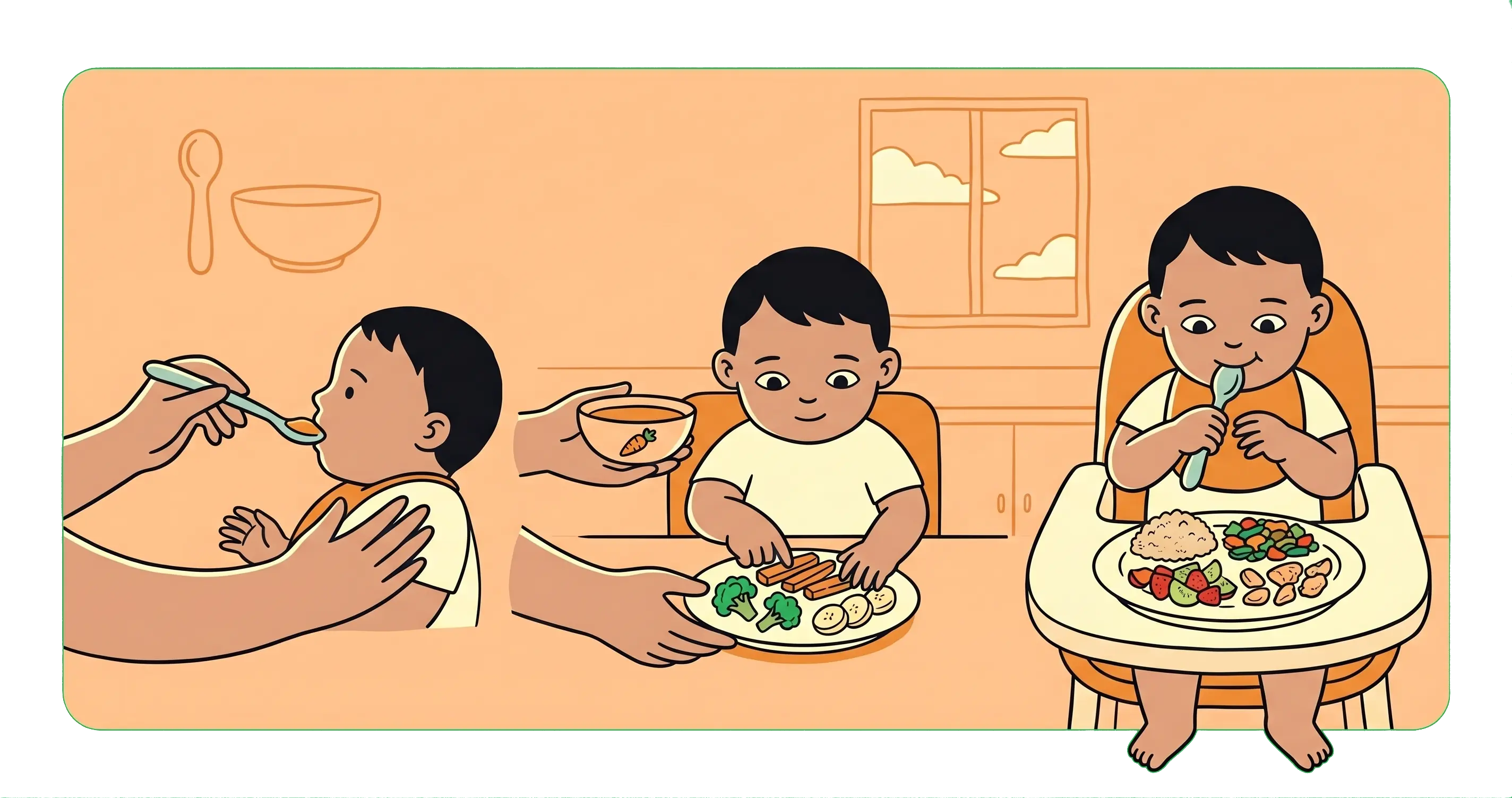
The first 2–4 weeks are worth treating as a familiarization stage. The child learns: - how to grab food, - how to bring it to the mouth, - what to do with a new texture, - how to participate in a meal with the family.
In our work with families, we often hear after the first week: "He just crushes everything in his hands." And honestly? That's a very typical start. For the child, it's also an important lesson — they learn about food through touch as intensely as through taste.
How Long Should a Meal Last
There's no need to sit at the table until it's "done." Initially, 10–20 minutes is usually enough, sometimes even less. If you see the child starting to get upset, turning their head, or dropping everything without interest, it's often a sign that it's enough for today.
In practice, it's better to finish a little too early than a little too late. This way, the child doesn't start associating the meal with overload and tension.
How to Assess Progress
At the start, we don't focus mainly on how much was eaten. It's much more important whether the child: - wants to touch the food, - is increasingly confident in grabbing it, - puts it in the mouth, - licks, bites, crushes, - sits more calmly at the table.
From our experience, parents usually notice the first significant changes after 1–2 weeks, and greater ease after a few more. It really doesn't have to happen right away.
First Foods: What Usually Works Best
Parents often think that BLW requires special recipes or a complicated menu. But in practice, the best things are simple, soft, and easy to grab. The less fuss at the beginning, the easier it is to stay calm.
We most often start with products that easily break apart when pressed with fingers. It's a simple home test that really helps make decisions. If you can easily crush a piece without effort, the child will usually find it easier too.
At the beginning, the following work well: - ripe banana, - soft avocado, - well-cooked sweet potato, - soft cooked carrot, - broccoli cooked to a very soft consistency, - ripe pear or mango, - omelet strip, - soft tofu.
It's Not Just the Product, but Also the Form
How you serve food often matters more than what you choose. At the beginning, larger pieces or thick sticks that the child can grab with their whole hand usually work better. Part of the food should stick out beyond the fist, as it's easier to bring it to the mouth this way.
In practice, we see that small pieces often frustrate more than help. They seem "safe" to the parent, but the child finds them hard to grab and maneuver sensibly.
How Many Products to Offer at Once
At the start, there's really no need to make a "tasting board." We usually recommend: - 1 product at the very beginning or - 2–3 simple products in one meal.
For the first 7–14 days, repetition works well. The same product can come back several times, and that's okay. In our work, it's often these calm repetitions that give the child the most confidence.
What to Avoid Offering at the Beginning
This part usually reassures parents because it's easier to cook when you know not only what to offer but also what to avoid for now. In practice, the biggest problems are caused by products that are hard, small, round, or slippery.
At the beginning, it's better not to offer: - whole grapes, - whole cherry tomatoes, - hard pieces of raw apple, - raw hard carrot, - whole nuts, - small, hard snacks, - slices of sausage, - small round pieces of food.
In our work with families, we regularly see the same mistake: the food is soft but cut in a way that the child can't grab it well or the piece has an unfavorable shape. That's why we always look at the whole: softness, size, and way of serving.
If you're unsure, ask yourself two questions: 1. Can it be easily crushed with fingers? 2. Can the child comfortably grab it with their whole hand?
If the answer to either of these questions is "not really," it's better to change the way it's served.
Gagging or Choking? It's Really Not the Same
This topic comes up repeatedly — and we totally understand why. For many parents, the first cough at the table sounds like an alarm. From our experience, however, what often looks scary is simply the child's natural defensive reaction. 🍽️
When a child gags, they may cough, grunt, make faces, have tears in their eyes, or push food out with their tongue. It can be hard to watch, but it usually means the body is working and trying to handle the piece.
The simplest rule we repeat to parents is: if the child is coughing, breathing, making sounds — we observe and stay calm. We don't blindly put fingers in the mouth and don't act in panic.
Choking looks different. Here, the child can't effectively breathe or cough, becomes silent, and the situation requires immediate action. Therefore, before starting BLW, it's very worthwhile to refresh basic infant first aid. Not to get worked up, but to have a plan in mind.
In practice, after a few meals, parents start to distinguish these situations much better. We remember a mom who was sure after the first "bleh" that BLW wasn't for them. A week later, she wrote that now she sees the difference and feels much calmer at the table. This happens very often.
Common Mistakes That Unnecessarily Add Stress
In our work with families, we see a few recurring traps. The good news is that most of them can be easily spotted and corrected without turning everything upside down.
1. Judging the Meal Only by How Much the Child Ate
This is probably the most common flashpoint. A parent looks at the tray after the meal and thinks: "he hardly ate anything." And we look and see a child who touched, crushed, licked, and hit the mouth a few times — which is really a lot.
At the beginning, milk remains the foundation, and solid food is a learning experience. If for the first days or even 1–2 weeks the amounts are symbolic, it really doesn't have to mean a problem.
2. Offering Food at the Wrong Time of Day
When the child is very hungry, sleepy, or irritable, the meal usually goes worse. In practice, it's not a matter of "dislike for BLW," just a bad moment.
Most often, the best time is when the child is: - calm, - rested, - curious, - ready to sit at the table for a while.
3. Too Many New Things at Once
Sometimes, with good intentions, parents offer five products at once because they want to give the child a choice. And then the child is overstimulated, squeezes everything at once, and quickly gets tired. From our experience, less really means more.
4. Pressure for It to "Go Well"
The child very much senses tension at the table. If every bite is watched like an exam, the atmosphere becomes difficult for everyone. In practice, simple presence, calmness, and acceptance that beginnings can be messy work much better.
FAQ: Questions We Hear Most Often
Is It Normal for the Child to Eat Almost Nothing at the Start?
Yes, this is very often how the start looks. For the first days, and sometimes for 1–2 weeks, the child is more exploring the food than eating it. It's normal.
How Many Products to Offer in the First Meal?
Usually, 1–3 products are enough. If you see the child easily distracted, start with just one.
Do We Still Offer Milk After Starting BLW?
Yes. At the beginning, milk remains the foundation of nutrition, and solid food is a stage of learning and familiarization.
How Long Should the First Meal Last?
Usually, 10–20 minutes is enough. There's no point in dragging it out if the child clearly has had enough.
Do We Need to Introduce a New Product Every Day?
No. In practice, repeating the same simple products for a few days helps both the child and the parent a lot.
Summary: What to Start With Today
If you want to start BLW without excess stress, begin with simple basics. Check if the child: - sits stably in the high chair, - holds head and torso upright, - doesn't slump to the sides, - grabs objects and brings them to the mouth, - is interested in food at the table.
Then choose 1 calm moment of the day, offer a soft product in an easy-to-grab form, and give the child time. No rush, no pressure, and no expectation of "eating the whole meal" right away. From our experience, these calm beginnings yield the best results after 1–2 weeks, and after a few more, they build increasing confidence on both sides. 😊
If you want, we can help you create a safe BLW start plan tailored to your child and your daily life. Check out the consultation form — we'll calmly discuss the best place to start.