Child Won't Eat Vegetables? 10 Ways to Encourage Without Forcing
When a Child Pushes Vegetables Away, Parents Often Start to Worry
"He used to eat cucumbers, and now he won't even look at them" — we hear this from parents quite often 🥕 Let us reassure you: this doesn't necessarily mean you have a "picky eater" or that something has gone wrong. In our work with families, these dining table dramas are quite common.
In practice, we see that children might reject a vegetable not because they "don't like it," but because today the skin bothers them, the wet surface, seeds, or even that the piece is cut differently than usual. Does it sound trivial? Maybe a little. But for a child, these details often matter a lot.
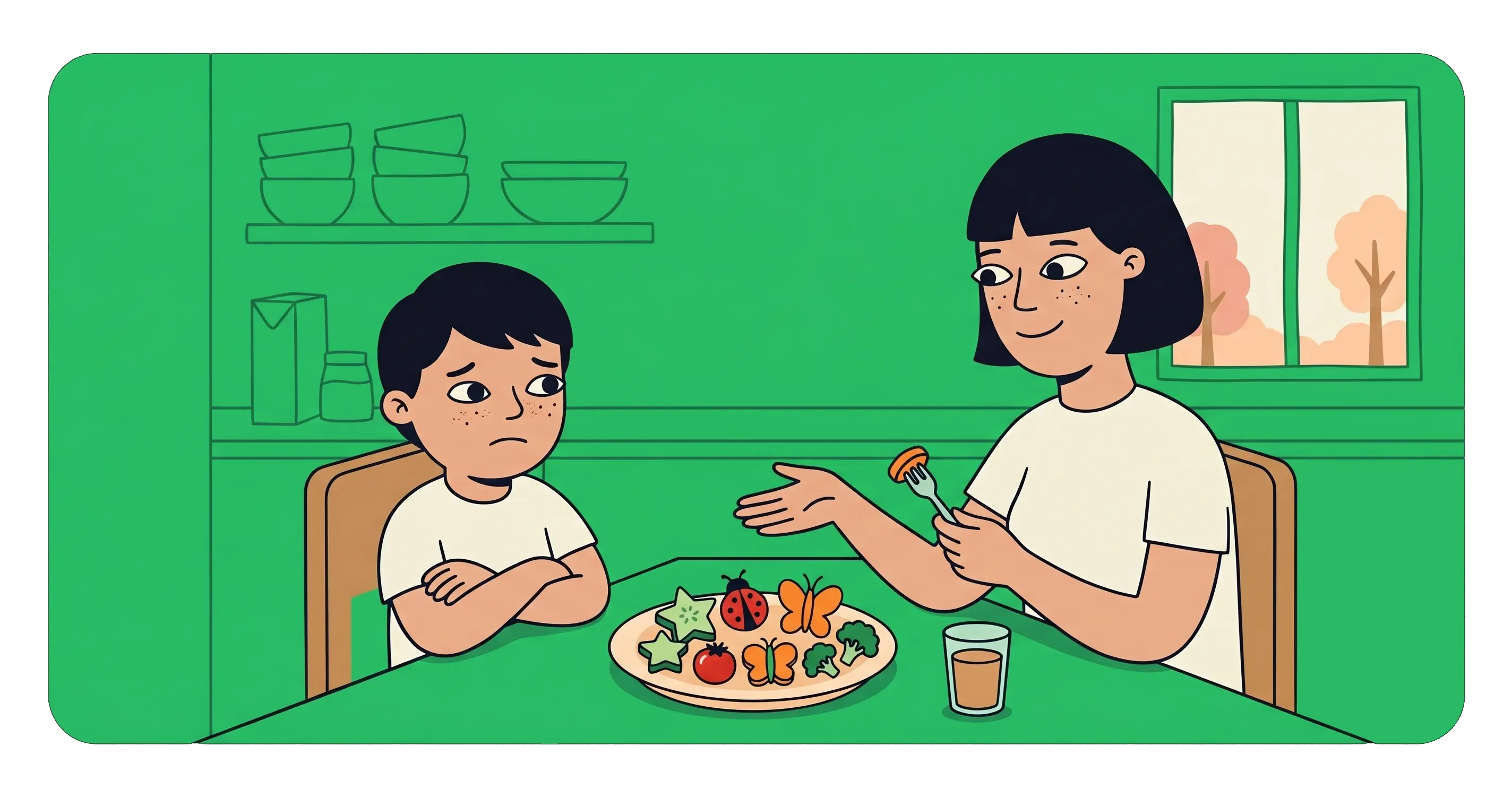
The biggest challenges usually arise not from the vegetable itself but from the tension surrounding it. When phrases like "just try a piece" or "one more bite" appear at the table, the atmosphere quickly becomes tense 🍽️ And then the child closes off even more.
In this article, we'll show you where the aversion to vegetables comes from, what to avoid doing, and how to calmly increase the chances that your child will start trying them on their own. From our experience, small changes often appear after 2–3 weeks when parents ease off the pressure and implement a simple plan.
Why Doesn't a Child Want to Eat Vegetables?
From our experience, it's often just a phase. A child grows, their appetite changes, their caution towards new tastes, and their tolerance for different textures. One day a tomato is fine, the next "not anymore" — and this doesn't have to be unusual.
In practice, we observe that for a child, a vegetable is not just about taste. Everything else matters too:
- the smell when cut or cooked,
- texture,
- skin, seeds, fibers,
- temperature,
- presentation and cutting method.
That's why the same happens with cucumbers, carrots, or broccoli. Cucumber sticks might go down without a problem, but in a salad, they might not. Roasted carrots can be easier than boiled ones. Broccoli served separately is sometimes acceptable, but mixed with rice, it's not.
We remember a boy who rejected "carrots" for a long time, but after a few conversations with his parents, it turned out it wasn't about carrots in general — just the soft, overcooked version. Roasted sticks suddenly became "okay." We see such situations quite often, which is why we focus so much on form, not just the product itself.
When Is It Still a Typical Difficulty, and When Is It Worth Seeking Support?
Parents often ask us where the line is between "it will pass" and "it's worth checking out." In our practice, a typical difficulty with vegetables usually looks like this: the child eats selectively, changes their mind day by day, but otherwise has a few safe products and doesn't react with strong fear at the sight of food.
We pay closer attention when the problem extends beyond just vegetables. If a child is afraid to try, has a very short list of accepted products, or reacts very strongly to the smell or touch of food, it's worth not waiting too long.
Signs that suggest considering a consultation include:
- very strong fear of trying,
- gag reflex with many products,
- panic or crying at the mere presentation of a meal,
- very few accepted dishes,
- high tension at the table almost daily,
- difficulty gaining weight or eating in general.
From our experience, we also know that parents often wait "a little longer," hoping it will pass on its own. Sometimes it does, but sometimes a few simple changes introduced earlier provide the family with great relief within 2–4 weeks. And that's without battles, threats, or daily negotiations.
Common Mistakes with Vegetables
In our work with families, we rarely see a "lack of effort." Usually, it's the opposite — the parent tries very hard, but focuses too much on getting the child to eat now. And that's where the problems often begin.
The most burdensome situations are: - coaxing for more bites, - bargaining over the number of bites, - feeding despite clear resistance, - promising rewards for eating vegetables, - making vegetables the main topic of the meal.
In the short term, this sometimes works. The child eats a piece, the parent feels relieved, "it worked." But in practice, we often see that after a few days or weeks, vegetables start to be associated with pressure 😟 And then resistance usually grows, not decreases.
We once had a girl in our office who would say "no" at the word "broccoli" before even seeing the plate. Not because broccoli was so terrible, but because every dinner ended with a conversation about how much she had to eat. When the parents stopped pushing and simply placed a small piece next to the meal, after a few days, she touched it on her own. For many families, this small first step is a breakthrough.
What Works Better Than Coaxing?
From our experience, calm familiarization works best, not convincing. A child doesn't have to eat a vegetable immediately to make progress. Sometimes the first success is that the vegetable stays on the plate without protest. Other times, it's that the child touches it, smells it, or licks it.
This is important because, in practice, this is how tolerance for a new product is built. Without testing, without judging, without "see, you did it." The less pressure, the greater the chance the child will take a step forward on their own 🥒
Regular Contact Without the Obligation to Eat
The simplest rule is: we show vegetables regularly, but don't force eating. A small piece next to a familiar meal, a few times a week, is really enough to start.
You can use simple phrases: - "I'll put it next to you, if you want, you can try it." - "You don't have to eat it." - "You can just look at it." - "No need to try today."
From our experience, such neutral messages make a huge difference. The child feels they don't have to prove anything.
Shared Table and Calm Example
In practice, what you do also helps a lot. If vegetables are a regular part of a shared meal, not a "task for the child," the tension significantly decreases. There's no need to comment on every bite or encourage every minute.
It helps when: - we eat together at least one meal a day, - we serve ourselves vegetables, - we don't overpraise for one bite, - we don't make trying a big event.
In our work with families, we often see that when a parent stops monitoring every fork movement, the child becomes more relaxed. Paradoxically, curiosity appears more often then.
How to Serve Vegetables to Increase the Chance of Acceptance?
Very often, it's not about whether the child will eat the vegetable, but in what form they can accept it. This is one of those things that make the biggest difference in practice. Sometimes changing the way it's cut or the temperature suddenly reduces resistance.
What often works well are: - roasted sticks, - vegetables cooked until soft but not falling apart, - small pieces served separately, - simple additions to a familiar dish, - vegetables with a mild dip or sauce.
At the start, we usually recommend 1–2 small pieces, not half a plate. A large portion of a new product often looks overwhelming to a child. A small piece gives a greater sense of security and doesn't spoil the whole meal.
In practice, it's also better to avoid at first: - large mixes, - salads with many ingredients, - vegetables "hidden" under a thick layer of sauce, - very overcooked, unpredictable textures.
We remember a mom who was convinced her son "hated zucchini." After a few tries, it turned out he didn't accept soft, watery zucchini from the pan, but roasted, slightly browned zucchini was eaten without much problem. Such nuances really matter.
10 Ways to Help Without Battles at the Table
Parents often ask us for specifics: "Okay, but what should we do every day?" That's why we've gathered the rules that work best in practice 🍅
- Serve vegetables regularly, even if the child doesn't eat them.
- Don't count bites and don't set a minimum to eat.
- Give small portions, so as not to overwhelm.
- Leave something safe on the plate that the child usually accepts.
- Allow contact without eating — touching counts too.
- Don't reward with dessert for vegetables.
- Don't scare with health and don't shame.
- Involve the child in preparation — washing, choosing colors, arranging on the plate.
- Test different serving forms of the same vegetable.
- Speak calmly and neutrally, without pressure and without theatrical delight.
Short sentences also work well: - "The vegetable is on the table." - "You can decide for yourself." - "Today it's just next to you."
This sounds simple, but simplicity usually works best. In our work with families, the biggest change often comes not from a "smarter method," but from a calmer atmosphere.
How to Plan the Introduction of New Vegetables?
If you want to start fresh, you don't have to make a revolution right away. In practice, a small plan works better than a big push for three days. Choose one vegetable and return to it calmly over time, instead of offering something different every day.
We usually recommend this simple scheme: - choose 1 vegetable to start, - serve it every 2–3 days, - change only one element at a time, - observe what was easier: temperature, form, piece size, - note not only "ate," but also "touched," "smelled," "left without protest."
This last part really helps. From our experience, parents often see only after a few days that the child is making progress — but not always in the form of an eaten bite. Sometimes the success is that the vegetable is no longer a problem in itself.
In practice, attempts often work better at a calmer time of day when the child is not extremely hungry or very tired. In the evening, patience is often already running low — on both sides 😉 That's why it's worth checking if it might be easier at lunch or an earlier dinner.
Simple Vegetable Formats That Are Often Easier
Not every child will immediately like salads or stir-fried vegetables. From our experience, predictable, soft, or easy-to-grab forms are often easier. The fewer surprises inside, the usually calmer it is at the table.
What often works well are: - roasted carrot, sweet potato, or zucchini sticks, - broccoli cooked until soft, - smooth cream soups, - vegetable pancakes, - mild vegetable sauces for pasta.
3 Simple Ideas to Start
1. Roasted Carrot and Zucchini Sticks
Cut the vegetables into thicker pieces, drizzle with a bit of olive oil, and roast for about 20–25 minutes. They should be soft but not falling apart. At first, place 2–3 pieces next to a familiar meal.
2. Carrot and Potato Cream Soup
Cook the vegetables until soft and blend until smooth. If your child prefers milder flavors, you can add a bit of natural yogurt. Serve a small portion, preferably next to something familiar, like bread.
3. Zucchini Pancakes
Grate the zucchini, squeeze out the excess liquid, mix with egg and flour, and then fry small pancakes or bake them in the oven. This is a good option for children who prefer a solid, predictable form.
Parents also often ask us about "sneaking." We take a calm approach: it can help increase the amount of vegetables in the diet, but it's not worth relying solely on it. If the vegetable is always hidden, the child doesn't have the chance to get used to it in its plain form. That's why it's best to combine both methods — some vegetables in the dish and a small piece on the side, without pressure.
Summary: Small Steps Really Make Sense
If your child doesn't want to eat vegetables, you don't have to assume the worst right away. In our work with families, we see much more often simple caution, variability, and the need for greater predictability than "stubbornness" or "malice" from the child 🌱
The most important things to remember: - don't force, - serve regularly, - start with small portions, - test different forms, - ensure a calm atmosphere at the table.
From our experience, improvement usually doesn't come overnight. First, there's less tension, then greater tolerance, and only later trying. And that's okay.
If you feel that the topic of vegetables is heavily burdening your daily life, you can reach out to us through the NutritionHelper consultation form. We'll help you create a simple, realistic plan tailored to your child.