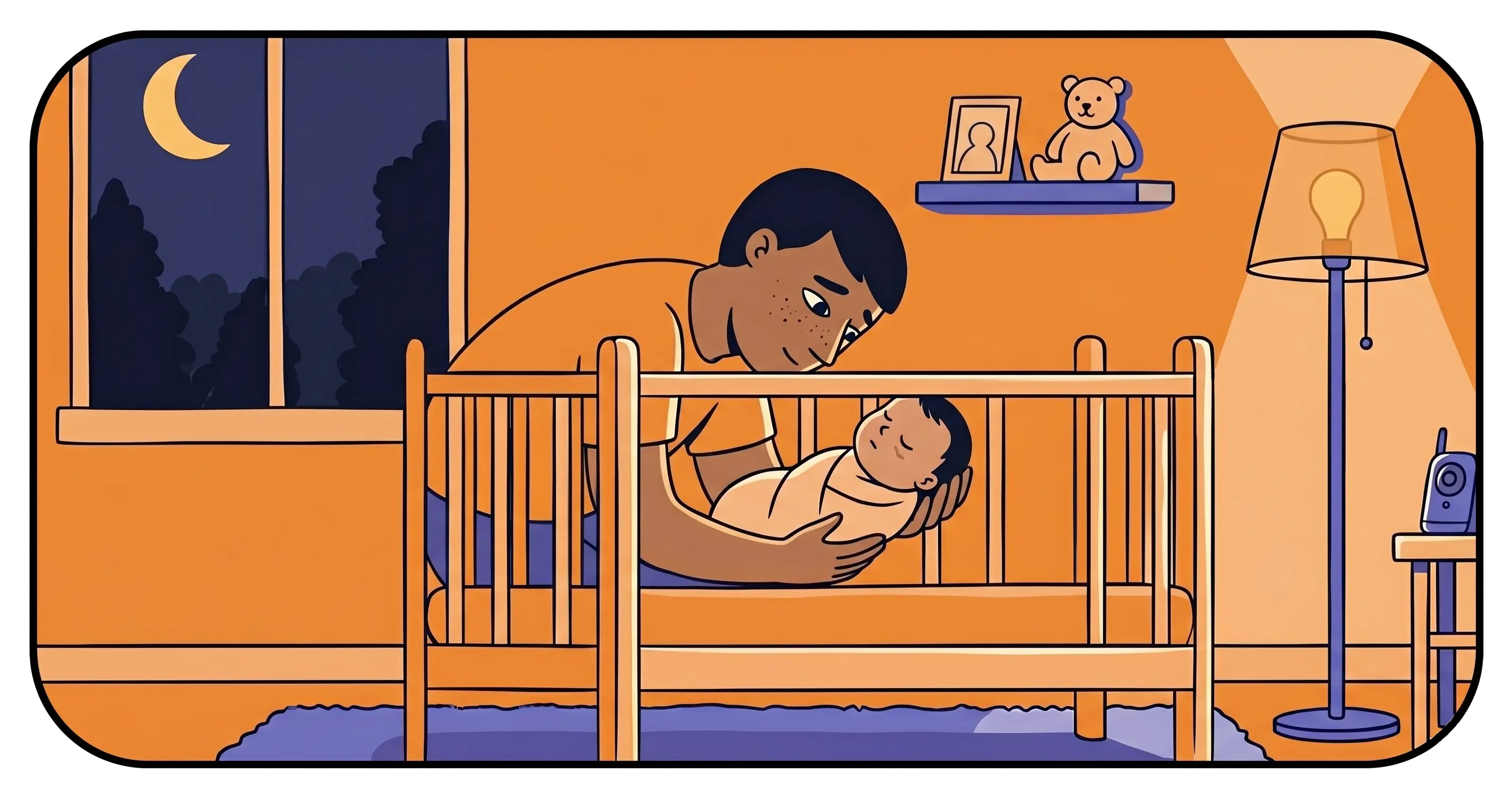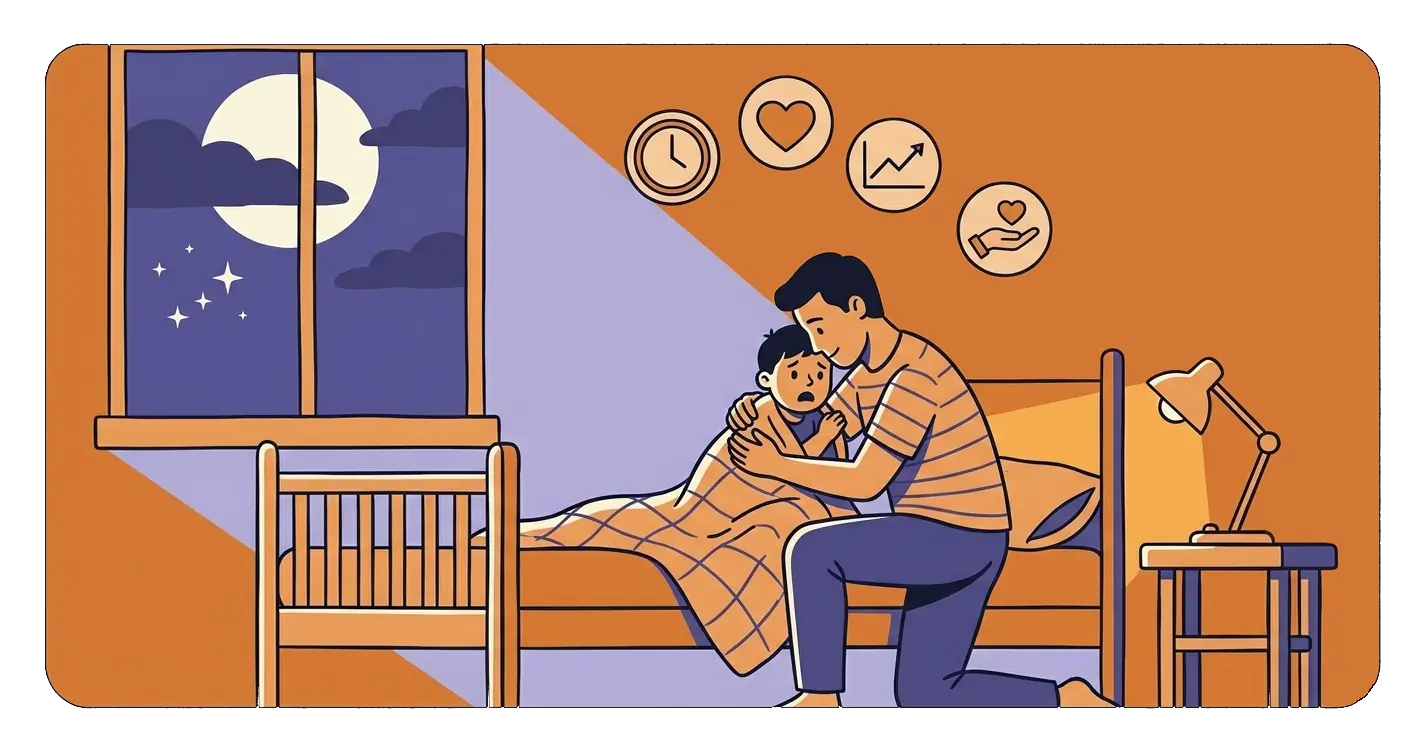
4-Month Sleep Regression: What's Happening and How to Cope?
“Things were getting better... and now it's one wake-up after another?”
Parents often reach out to us at a very similar point: “What happened? Things were improving” 😵💫 We see this often in practice — a baby who was starting to sleep for longer stretches suddenly wakes more frequently, has trouble falling asleep, and seems to dislike being put down in the crib overnight.
If you're experiencing this, we want to assure you: it doesn't mean you've done something wrong. From our experience, this is usually a phase where your baby's sleep simply starts to function differently than before. To a parent, it may seem like chaos, but for the baby, it's a significant internal change.
During this time, you might notice several things at once:
- your baby wakes more frequently than before,
- naps become short and fragmented,
- it's harder to find the right bedtime in the evening,
- the second half of the night is often more challenging than the beginning.
In the following sections, we'll show you how to recognize a typical 4-month regression, when to consider other causes, and what you can do to bring some calm to your home 🤍 Many families notice small improvements within 3–5 days, with greater relief coming in 1–2 weeks of more consistent action.
What actually changes around the 4th month?
From our experience, it's not that a baby suddenly “forgets how to sleep.” It's more that sleep becomes less like a newborn's and more sensitive to the conditions around falling asleep and waking up. Parents see more frequent awakenings, while we often see just a transitional phase that presents a very similar picture for many infants.
In practice, this looks like the baby more frequently “emerges” from sleep. And that's when it starts to matter how they fell asleep and in what conditions they wake up. If falling asleep was heavily associated with being held, fed, rocked, or constant contact, the baby might more often call for exactly the same help.
We remember a family we worked with, where the mom said: “Evenings are still okay, but after midnight, it’s a marathon.” This is a very typical scenario. In practice, often the first part of the night is the calmest, and later sleep becomes lighter and more fragmented.
This is also a time when a random daily rhythm stops being enough. What previously “fell into place” often now requires a bit more predictability. The good news? It can be organized, usually without major upheavals.
How to easily recognize the 4-month sleep regression?
Parents often ask us: “How do I know it's this and not just a rough week?” From our experience, the most important sign is a sudden change. A baby who slept somewhat predictably suddenly needs much more support and wakes more frequently.
A very common signal is also naps ending after 30–40 minutes. In practice, we see a baby who seems to reach the end of one sleep cycle and doesn't quite know how to continue. Parents feel like “they're still sleepy,” yet the nap abruptly ends.
Common symptoms we see in families 👶
- night awakenings every 1–2 hours,
- short naps, often single-cycle,
- greater difficulty falling asleep despite being tired,
- more fussiness in the early morning,
- restlessness, whimpering, lighter sleep.
In our work with families, we also notice smaller signals that are easy to overlook. A baby might suck their hands, rub their face against the mattress, fuss a bit, and then quiet down again. It's not always a full awakening — sometimes it's just a transitional moment where the baby is trying to self-soothe.
It's also important to remember that this stage doesn't look the same for everyone. One baby might wake constantly for a week, another might mainly shorten naps, while another has particularly difficult evenings. It can still be the same developmental moment, just in a different form.
Regression or something else? How to distinguish without guessing
From our experience, not every tough night around the 4th month is immediately a regression. Sometimes the picture is very typical, but sometimes underlying issues like hunger, infection, discomfort, or simply a daily schedule that no longer suits the baby are at play. That's why we always encourage looking at the bigger picture, not just the night 👀
When does it really look like a regression?
We usually think of regression when:
- the sleep deterioration occurs quite suddenly,
- the start of the night is still relatively calm,
- difficulties increase after midnight or in the early morning,
- naps shorten to 30–40 minutes,
- the baby needs more predictability during the day.
In practice, we see a certain pattern: it's not just about the number of awakenings, but the overall day and night pattern. Parents often say: “Everything feels more fragile.” And that's a very accurate description.
What can give a similar picture?
We usually check these things first:
- hunger — the baby demands food more often during the day too,
- infection — there's a decline in well-being, runny nose, fever,
- discomfort after feeding — arching, spitting up, reluctance to lie down,
- teething — increased biting, drooling, greater irritability,
- poorly timed wake windows — the baby is put down too late or too early.
We once had a consultation with a family who was sure it was a “terrible regression,” but the biggest issue turned out to be stretching every evening by 40–50 minutes. After adjusting the daily schedule, the nights didn't become perfect immediately, but it was noticeably easier after just a few days.
When to consult a pediatrician?
Don't hesitate if you notice:
- fever,
- significant loss of appetite,
- breathing difficulties,
- crying that can't usually be soothed,
- signs of pain,
- poor weight gain.
If difficulties persist for over 2 weeks and you don't see any trend towards improvement, it's worth checking if it's just a transitional phase. Sometimes the problem isn't the regression itself, but what has become ingrained alongside it.
How long does it usually last?
Parents really want a specific answer, and we completely understand that. From our experience, the most intense wave of difficulties usually lasts about 7–14 days, though it doesn't always look linear. Sometimes after two terrible nights, there's one quite bearable, and parents think it's over — then it gets tough again.
In practice, it's better to look at the whole week, not just a single night. If after a few days you organize the daily schedule, calm the evening, and respond more consistently, that's often when you start to see the first small signs of improvement.
It usually looks like this:
- first, falling asleep becomes more difficult,
- then naps shorten,
- later, more night awakenings occur,
- finally, sleep begins to stabilize slowly.
If after 2–4 weeks it's still very difficult, it's usually worth taking a closer look. In our practice, this is often when various factors overlap: developmental change, overtiredness, and a method of helping to fall asleep that no longer works as well as before.
How to organize the day to avoid adding to your baby's fatigue?
In practice, we observe that around the 4th month, many babies start reacting much more strongly to daytime chaos. Just a moment ago, you could “get by” on random naps, and now the same setup ends with a cranky afternoon and difficult evening 😵💫
For many families, a day based on 3–4 naps and a fairly predictable start to the night works well. Often, a wake-up around 6:00 to 7:00 am and bedtime around 6:00–7:30 pm is helpful. However, it's not a race against the clock — it's more about the framework than the minutes.
What to watch for during the day?
From our experience, the best approach is a combination of observing the baby and lightly keeping track of time. Around the 4th month, the first wake window after the morning wake-up is often the shortest. Later, many babies function well with wake windows of about 1.5–2 hours, but it's always worth watching the baby's behavior too.
Signals that it's time to slow down include:
- turning away,
- “zoning out,”
- sucking hands,
- whimpering without a clear reason,
- greater irritability during play.
In our work, we often see one simple mistake: parents wait for very clear signs of sleepiness, and by then the baby is already too tired. And that's when falling asleep becomes the most stressful.
What to do when naps fall apart?
If naps suddenly end after 30 minutes, we usually don't recommend extending wake time “to tire them out more”. It sounds logical, but in practice, it often makes the evening and night worse.
Instead, it's worth:
- shortening the next wake window by 10–15 minutes,
- not stretching the evening unnecessarily,
- offering the next nap sooner after a poor nap,
- keeping a fairly consistent bedtime,
- looking at the whole day, not just one nap.
For many families, these simple adjustments bring the first relief after 2–4 days, and clearer order after 1–2 weeks 🌙
How to help without falling into a vicious cycle?
This is probably one of the most common questions we hear. Parents are tired, the baby is too, so naturally, they want to do anything just to get everyone to sleep. And that's completely understandable. From our experience, what works best is not “more of everything,” but more predictable, calm help.
A rule that often saves nights: help, but gradually
It's not about suddenly stopping support for your baby. It's more about not immediately resorting to the strongest form of help at every stir. If a baby knows only one way to fall asleep — like intense rocking to full sleep — they might later demand exactly the same more often.
In practice, we recommend small steps:
- start with voice and presence,
- then a hand on the body or gentle soothing in the crib,
- only later pick up if it's really needed.
We remember a dad who, after a few days of this calmer response, told us: “What surprised me most was that not every night-time action required picking up.” This sentence captures the essence of this stage very well.
What usually helps the most?
Most often, the following are effective:
- a short and repeatable evening routine,
- a similar way of responding to night awakenings,
- putting the baby down when they're calm but not always fully “asleep,”
- pausing if the baby just murmurs, squirms, or sucks their hand,
- avoiding overly intense help from the first second.
In practice, we see that even greater consistency makes a big difference. Not because the baby suddenly starts sleeping perfectly, but because the night becomes more predictable and less chaotic.
Common mistakes we see during this period
In our work with families, a few things come up regularly. The first is overtiredness disguised as “he doesn't want to sleep”. The baby protests, arches, seems stimulated, so the parent thinks it's not time yet. And after 20–30 minutes, it's only harder.
The second common issue is a too chaotic day. Sometimes three naps, sometimes five, sometimes bedtime at 6:15 pm, other times after 8:00 pm. Of course, life with an infant won't be perfectly even, but from our experience, even a bit of predictability makes a huge difference.
The third trap is responding immediately with maximum intensity. When a parent is exhausted, it's very tempting. But in practice, often a moment of observation and gradual help works better.
What usually brings the quickest improvement?
- returning to a simpler daily plan for 5–7 days,
- shortening wake time if falling asleep becomes a struggle,
- a more consistent bedtime,
- a calmer, shorter evening routine,
- a similar reaction to similar awakenings.
For many families, the first improvement comes after a few days, and a bigger change after 2–3 weeks. Not perfect, not magical, but enough for the home to start breathing again.
A few myths that only add stress
Parents often hear that every child must go through this stage dramatically. From our experience, this is simply not true. Some babies go through it very noticeably, others much more gently. Sometimes the most visible issue is short naps, and sometimes it's mainly early morning awakenings.
The second myth is: “If sleep has deteriorated, it means we've accustomed the baby to bad habits”. We see it more gently. Around the 4th month, many babies simply start needing more predictability, and what worked fine before no longer suffices.
And one more important thing: you don't have to make a big revolution right away. In practice, we first organize the basics — the daily rhythm, evening, way of responding. Only then do we assess if more is needed. Very often, this is enough to make nights easier to handle.
Summary: What really helps to get through this stage
If we are to leave you with a few key thoughts, they would be these: this is usually a transitional phase, not your failure, and it can be navigated more calmly. From our experience, the biggest difference is made not by complicated tricks, but by simple things done consistently.
The most helpful are:
- a fairly predictable day,
- not extending wake times,
- a calm, repeatable evening,
- gradual help with awakenings,
- looking at trends over several days, not just one tough night.
And very honestly — take care of yourself too. In practice, we see that when a parent is completely at the limit, everything seems even harder. If you can, split the night into shifts, ask for help from a partner, or try to catch a bit of rest once a day 🤍
If you feel that for you it's no longer just a temporary stage, or you simply want to organize the daily plan and nights without guessing, check out our SleepComplainer consultation form. We'll calmly look at your situation and help create a realistic plan.