Prohibited Foods for Infants: What Not to Give Before Their First Birthday
It Starts Innocently: "It's Just a Little Bit"
Parents often ask us: "Does one teaspoon really make a difference?" And that's where the chaos often begins when introducing new foods. In our work with families, we see this frequently — something seems harmless, grandma encourages it, the label looks "child-friendly," yet it's not the right time for the baby 👶
Before the first birthday, it's not about perfection but a few simple rules that truly make life easier. A baby's body is still maturing, so not everything that suits an older child or adult is appropriate now. In practice, it's not just about what you offer, but also how much, in what form, and how fresh the food is.
To organize this, it's best to think of food in three categories: - foods we simply don't offer before 12 months, - foods to significantly limit, - foods that might be okay but only if well-prepared.
This approach usually reassures parents. We don't lump everything into one "prohibited" category but look practically: what to postpone, what to change, and what to offer cautiously 🙂
What Really Should Be Avoided Before the First Year
In practice, a short, specific list provides the greatest relief. When you know what not to offer, daily decisions become simpler. You don't have to guess every time at the jar, grandparents' dinner, or while shopping.
Do Not Offer These Before the First Year
- honey,
- salted dishes and added salt to the child's meals,
- sugar, sweets, and sweetened drinks,
- plant-based drinks as a milk substitute,
- raw meat,
- raw fish and seafood,
- raw or undercooked eggs,
- forest mushrooms,
- expired or improperly stored food.
Better to Avoid or Offer Very Rarely
- bouillon cubes,
- instant soups,
- ready-made sauces,
- sausages and most cold cuts,
- salty cheeses,
- highly processed "children's snacks".
The Problem Here is Mainly the Form of Serving
- whole nuts,
- whole grapes,
- hard pieces of apple,
- raw, hard carrots in large pieces,
- slippery, round pieces of food,
- large and dense chunks of meat.
From our experience, such a list works better than lengthy explanations. A parent opens the fridge, looks at the product, and immediately knows: serve, postpone, or change the form.
Honey, Salt, and Sugar – No Exceptions Here
This is the group where we most often hear: "But just a little bit". However, with an infant, that "little bit" is really unnecessary. In practice, we tell parents directly: if the child is not yet a year old, skip honey, salting, and sweetening 🍯
Honey
Do not add honey to porridge, tea, or homemade desserts. Even a symbolic amount is not a good idea here. If you want the meal to be mildly sweet, using fruit is a much safer option.
Salt
In our work with families, we often see that adults add salt out of habit, not malice. The problem is that an infant doesn't need such "enhancements". The simplest rule is: do not season the child's portion with salt.
Be particularly cautious with products where salt "hides" quietly: - bread, - yellow and processed cheeses, - cold cuts, - sausages, - ready-made soups and sauces, - spice mixes with additives.
Sugar
It's similar with sugar. It doesn't help the baby learn to eat — it often makes it harder. From our experience, if you regularly sweeten porridge, desserts, or drinks for a few days or weeks, the child quickly gets used to the very sweet taste and then struggles with simpler foods 🍓
What usually works instead? - for porridge: mashed banana, baked apple, soft pear, - for savory dishes: olive oil, butter, mild herbs, - for drinking: water.
We've had many consultations where parents said after 1–2 weeks: "He actually drinks water, we just kept offering something sweeter before". And this is a very common scenario.
What Not to Offer Due to Freshness and Food Safety
Some products aren't problematic because they are "bad in themselves," but because they must be prepared very thoroughly for an infant. In practice, we exercise the most caution with meat, fish, eggs, and ready meals that have been sitting for a while 🍽️
For a little one, choose food that is fresh and well-cooked. If you serve an egg, make sure it's fully cooked. If you're serving fish or meat, check that the center isn't raw and that there are no bones or hard fragments.
In our work with families, we regularly see one mistake: a child's meal sits on the counter "just a bit longer," then it's reheated, and later returned to the fridge. With an infant, it's better not to do this. It's safest to serve the meal immediately, and if you store something, keep it sealed and use it by the next day at the latest.
Be particularly cautious with: - buffet and counter food, - restaurant leftovers, - takeout meals reheated multiple times, - expired products, - dishes you're unsure about.
From our experience, a good rule is: if you have to ask "is this still good?" then for an infant, the answer is "do not serve".
Dangerous Doesn't Always Mean Forbidden – Sometimes It's About How It's Served
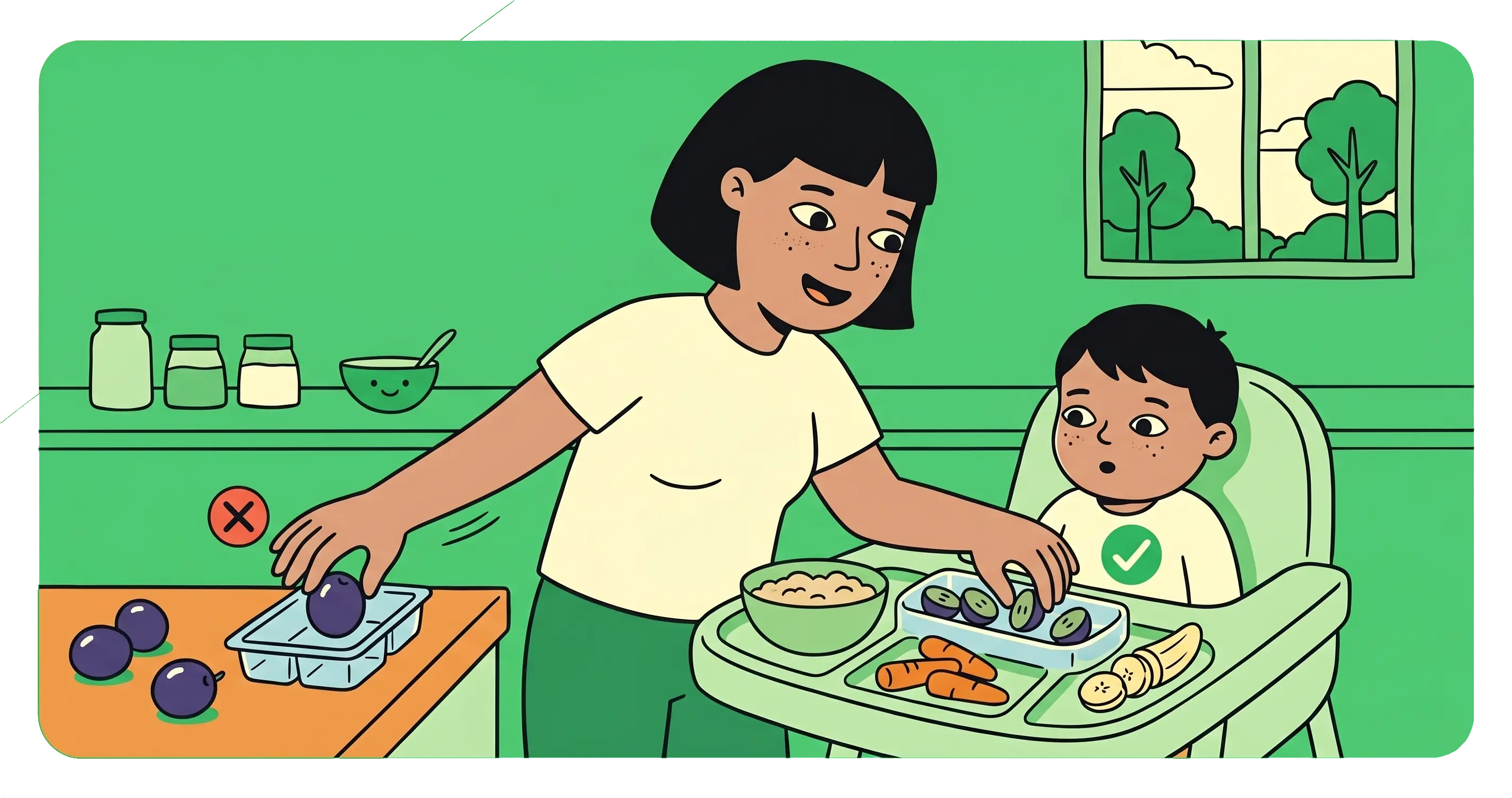
This is an important point because many parents hear "be careful" and immediately think "so it's not allowed at all." But that's not always the case. In practice, some products aren't problematic in themselves — the problem arises when they're served in a form that increases the risk of choking.
The most classic example is whole nuts. We don't give these to infants. But you can introduce the taste of nuts in other ways, like a smooth nut butter spread thinly on bread or mixed into oatmeal.
We look at it similarly with: - whole grapes, - hard pieces of apple, - raw, hard vegetables, - slippery round pieces of food, - large pieces of meat.
In practice, the best approach is food that is: - soft, - easy to mash with the tongue and gums, - cut appropriately for the child's age, - served when the baby is sitting calmly and under supervision.
From our experience, it's the little details that make the biggest difference. One change — slicing a grape lengthwise, shredding fish, cooking vegetables until soft — and the meal becomes much safer.
Eggs, Fish, Gluten, and Dairy – Not Forbidden, Just Sensible Introduction
Parents often ask us if these products should be left "for later." In practice, there's often no need. These aren't on the strictly forbidden list, but it's wise to introduce them calmly, one at a time, and in small amounts 👶
With eggs, the most important thing for us is that they are well-cooked. We don't complicate it more than necessary. If you're introducing something new, don't add three more things the same day — it's easier to see how the child reacts that way.
It's similar with fish, gluten, and dairy. In practice, we recommend a simple scheme: 1. Introduce one new product. 2. Offer a small portion. 3. Ensure a safe consistency. 4. Observe the child for 2–3 days.
Everyday examples: - fish: well-cooked, boneless, thoroughly shredded, - gluten: a small addition to a meal, not a large portion right away, - dairy: simple ingredients and small amounts instead of very salty or heavy products.
In our work with families, we see that a calm pace really pays off. Less chaos, less guessing, and less unnecessary stress at the table.
Common Traps: Juices, Teas, and "Baby Snacks"
It's easy to be misled here because many products look innocent. Colorful packaging, "for children" labels, promises of vitamins — and parents feel they're making a good choice. In practice, this group often hides a lot of sugar, salt, or simply too intense flavors.
We often see situations like these: - juice given instead of water, - sweetened porridge "to make it go down better", - sweetened tea every day, - crisps and desserts treated as a regular part of the diet, - sausages and cold cuts "because the child likes them", - ready meals with long ingredient lists.
From our experience, children really don't need so many "enhancements." If you simplify the menu for 1–2 weeks and return to natural flavors, you often see a big change. Parents then tell us that the child suddenly accepts plain porridge, water, or vegetables better — not because a miracle happened, but because the taste was lightened.
What usually works best? 🥄 - water as the main drink, - fruits instead of juices, - unsweetened porridge, - simple homemade meals, - as few highly processed products as possible.
We remember a mom who said in a consultation: "He doesn't want to drink water." After a few questions, it turned out he was getting sweet tea every day. After about a week of calm changes, water was no longer an issue. We see such stories regularly.
How to Read Labels Without a PhD in Food Technology
Parents often joke in consultations that to buy porridge or a pouch, you need a magnifying glass and a lot of patience. There's some truth to that. Fortunately, you don't have to analyze everything like a specialist — just a few simple points.
We usually start with two questions: - is this product even suitable for an infant? - is the ingredient list short and understandable?
Then we check if the list includes various forms of sweetening or unnecessary additives, such as: - juice concentrate, - concentrated fruit juice, - glucose syrup, - glucose-fructose syrup, - fruit syrups, - maltodextrin.
In practice, the label "no added sugar" doesn't always mean the product is a good choice. Sometimes the composition formally meets this condition, yet the taste is still very sweet. If a child receives such products daily, after 1–2 weeks, some children clearly start to prefer this intense flavor profile.
Our simple shopping shortcut: - the fewer ingredients, the better, - avoid products with honey, - don't choose items with added salt and syrups, - if something resembles a dessert more than a meal, leave it on the shelf.
It really doesn't have to be perfect. The goal is for most daily choices to be simple and safe.
When to Act Immediately After Eating
This topic stirs a lot of emotions, and we completely understand. Parents usually wonder: "Should I observe or react now?" In practice, after a new or unsuitable product, we pay attention mainly to how quickly symptoms appear and whether the child looks "like themselves."
Particularly concerning are: - hives, - sudden rash, - swelling of the lips, tongue, or eyelids, - severe vomiting shortly after a meal.
If the symptom is mild, but the child is breathing calmly and behaving normally, it's worth contacting a pediatrician the same day and continuing to observe the situation. From our experience, it's not just the symptom itself that matters, but also whether it escalates quickly.
However, there are signals where we don't wait: - wheezing, - difficulty breathing, - paleness, - limpness, - noticeable weakness, - rapidly increasing swelling of the face or tongue.
In such a situation, urgent medical help is needed 🚑
On a daily basis, the best practice is a simple habit: introduce new things during the day, not in the evening, and one at a time. This way, you have time to calmly see how the baby reacts.
Summary: Less Complication, More Simple Rules
If after reading all this you think: "That's a lot" — that's completely normal. In our work with families, we see that the topic can be overwhelming at first. But it usually turns out that a few clear rules make everyday life much simpler 🤍
The most important for this stage: - no honey, - no added salt or sugar, - no raw meat, fish, or eggs, - no plant-based drinks as a milk substitute, - no risky serving forms that may increase choking risk.
In practice, simple, fresh, and minimally processed food works best. Without "enhancements," without rushing, and without pressure that everything must be perfect from day one. From our experience, this calm approach yields the best results in the following weeks and months.
If you want to organize your baby's diet and get specific tips tailored to your situation, feel free to use our consultation form.