Iron Deficiency in Children: What to Eat with Low Ferritin
Introduction: "He Hardly Eats Anything" — and That's When Parents Start to Worry
Parents often reach out to us at a similar point: their child is paler, tires more quickly, eats less willingly, and seems to have lost their usual energy. Sometimes it appears subtle — a bit more fussiness, shorter playtime, more afternoon drowsiness. From our experience, these everyday details often start the conversation about low ferritin 😕.
Simply put, ferritin is like an iron reserve "for later". When this reserve shrinks, the body has less buffer, and the child may start to feel it, even if nothing seems dramatically wrong at first glance. In practice, we see that the earlier a parent examines the diet and symptoms, the easier it is to calmly organize a plan of action.
In our work with families, we often encounter a few recurring scenarios. A toddler over six months old has long relied mainly on milk. Another child eats very selectively, accepting only a few safe foods. Sometimes, the issue involves children born prematurely or with low birth weight, as they simply start from a more challenging position.
In this article, we'll show you: - what signals to watch for, - what often causes low ferritin, - how to plan meals to support iron, - and what a simple meal plan for children of different ages might look like 🍽️
Where Does Low Ferritin in Children Come From
From our experience, low ferritin rarely comes "out of nowhere." It's usually the result of a daily routine that doesn't provide the child with as much iron as they truly need over an extended period. Importantly, the cause in infants often looks different than in preschoolers or school-aged children.
In the youngest children, we often see a story that begins very early. If a baby was born prematurely or with low birth weight, their reserves might be modest from the start. Then comes the introduction of solid foods — sometimes delayed, sometimes lacking variety, sometimes based mainly on products that are "light" but don't contribute much iron.
In children between 1 and 3 years old, a very common picture is simple: lots of milk, few solids. Parents tell us: "if he could, he'd live on milk and bread." In practice, this is a really common setup, and if it lasts for weeks or months, iron reserves can gradually decrease.
In older children, the problem can be more insidious. The child eats regularly, but the menu is based on white bread, cereals, snacks, and quick options "just to eat something." Such a diet may seem fairly organized, yet it doesn't support rebuilding iron.
In practice, we also observe that low ferritin often goes hand in hand with food selectivity. If a child rejects meat, eggs, legumes, and most more nutritious meals, the parent naturally starts to rely on what "works." This is understandable, but over time it can contribute to the problem.
What Symptoms Are Easy to Miss
Parents often ask us: "How can you actually tell?" And honestly — it's not always easy to spot right away. In practice, we more often see a series of small changes rather than one clear alarm.
A child may be paler, sit on the couch more quickly, be less willing to go for a walk, or give up activities they previously enjoyed. Sometimes a parent says: "they seem to function normally, but just don't have their usual spark." It's a very apt description, and we hear it surprisingly often 👀.
For some children, the first signal is appetite. The child picks at food, pushes the plate away, prefers to drink, or chooses only the simplest products. For others, irritability, drowsiness, or difficulty concentrating on play or learning is more noticeable.
In our work with families, we've had many situations where a parent reported a "bad period," and after a few weeks, it turned out it wasn't a coincidence. We remember a boy who would lie down on the floor immediately after preschool and had no energy for anything else. After organizing his diet and further diagnostics, parents said they were most surprised by how much they had gotten used to his fatigue.
However, it's important to emphasize one thing: symptoms alone don't make a diagnosis. If something worries you, don't guess on your own. It's safest to consult a doctor and then determine what role diet should play.
What to Regularly Serve Your Child
Parents often look for a single product that will "solve the issue." From our experience, it doesn't work that way. The best approach is a consistent, simple plan where sources of iron return to the menu regularly, not just occasionally.
The most practical are products that can realistically be served several times a week. Many families find success with: - turkey, chicken, beef, veal, - eggs, - lentils, chickpeas, beans, - grains, oatmeal, quinoa, - selected iron-fortified cereals.
In practice, it's not about cooking something complicated every day. Sometimes it's enough to bake more meat for two days, make a lentil spread, boil eggs in advance, or have hummus and a simple cereal on hand to save the day. These are the solutions parents most often maintain for more than a week.
For younger children, "easy-to-accept" forms work well: meatballs, spreads, pancakes, soft patties, cream soups. In practice, we see that a child is much more likely to eat iron "hidden" in a familiar form than presented as a new, challenging piece on the plate.
We should also mention offal. They can appear occasionally, but from our experience, parents often overestimate their role. On a daily basis, it's much easier to base the menu on a calm rotation of meat, eggs, legumes, and grains — and this usually gives a more realistic effect than searching for one "strong" product.
How to Combine Meals for Maximum Benefit
In practice, simply "providing iron" is only half the job. The other half is how you combine the meal. And here, you really don't need a grand philosophy — just a few simple habits 🍓.
We often recommend one rule: add something with vitamin C to the iron source. This could be bell pepper, kiwi, strawberries, tomato, broccoli, parsley, orange, or pickles. Simple, without overthinking.
Good combinations include: - oatmeal + kiwi or strawberries, - egg salad sandwich + tomato, - hummus + bell pepper, - grains with turkey + salad, - lentils + parsley + tomato.
In our work with families, we often see that the biggest change comes from the little things. Not a new 14-page meal plan, but adding bell pepper to a sandwich, fruit to breakfast, and pickles to dinner. It sounds ordinary — and that's good because ordinary things are the easiest to maintain.
One mom we worked with once told us: "Only now do I see that I was serving good products, but completely randomly." It's a great summary. Sometimes you don't need to change the entire kitchen, just better organize what's already there.
What Can Hinder Iron Absorption
This is a topic that often surprises parents. Because sometimes a child receives iron-rich products, yet the effect is minimal. In practice, the problem often turns out to be the companions on the plate or in the cup 🥛.
We most often point out large amounts of dairy with main iron-rich meals. It's not about eliminating milk or yogurt from the diet. It's more about timing — if a child drinks a large cup of milk with a meat meal, it's not the best combination.
In practice, we usually suggest shifting dairy to another time of day. For example, give yogurt as a separate snack, not as an addition to lunch or dinner. It's a small change, but it often organizes the whole day.
We also look at cocoa, tea, and some grain beverages similarly. If we want to make the best use of iron, it's better not to place them next to a meal intended to support ferritin. It's much better to use: - water, - fruit with the meal, - vegetables with vitamin C, - light fruit mousse.
In practice, we also see another mistake: the diet looks very "fit," but the child eats too few substantial foods. Lots of bread, crunchy additions, snacks, seeds, and light options, but few real sources of iron. For parents, this can be frustrating because the food looks healthy — just not necessarily supporting what we currently need.
Common Mistakes We See in Families
One of the most common phrases we hear is: "But we give beets and spinach." And we understand that because these products have many associations. The problem is that add-ons alone won't build a diet plan for low ferritin 🥬.
In practice, we most often see these pitfalls: - too much milk during the day, - too little meat, eggs, legumes, or fortified products, - relying on fruit mousse to "solve the issue," - serving iron sources too infrequently, - basing the day on bread, dairy, and snacks.
From our experience, the biggest difference is made not by perfection, but by consistency. If a child has 1–2 specific opportunities to eat iron every day, after a few weeks, it's usually easier to notice a change than after sporadic "healthy actions" once every few days.
We also had a family convinced the problem was solved because the child ate "children's" breakfast cereals. When we outlined the whole day, it turned out that apart from that one element, there was practically nothing in the menu that truly supported rebuilding reserves. It's more common than you might think.
If you want to simplify the topic, start with three questions: 1. Does my child have a specific source of iron every day? 2. Do I add vitamin C to it? 3. Am I not drowning it all in milk or cocoa?
Sample Daily Meal Plan
Parents often ask us for something very specific: "Just show us how it should look in practice." And that's a very good question. Because the plan should be doable, not just look good on screen.
Child 1–3 Years
At this age, simplicity and calmly repeating familiar flavors usually work best. From our experience, parents often see the first positive changes in meal organization after a few days to 2 weeks, and a more noticeable effect usually takes longer.
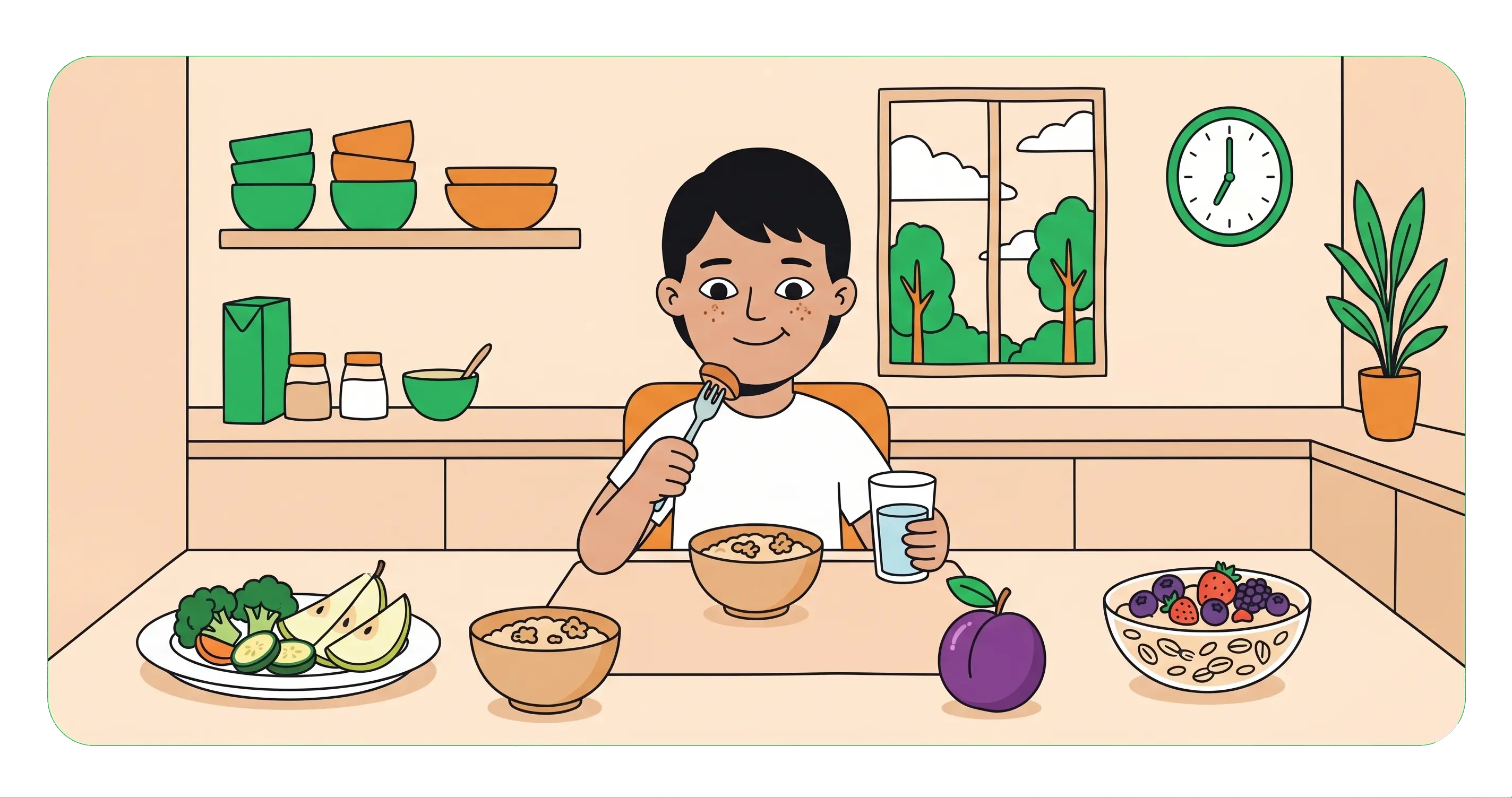
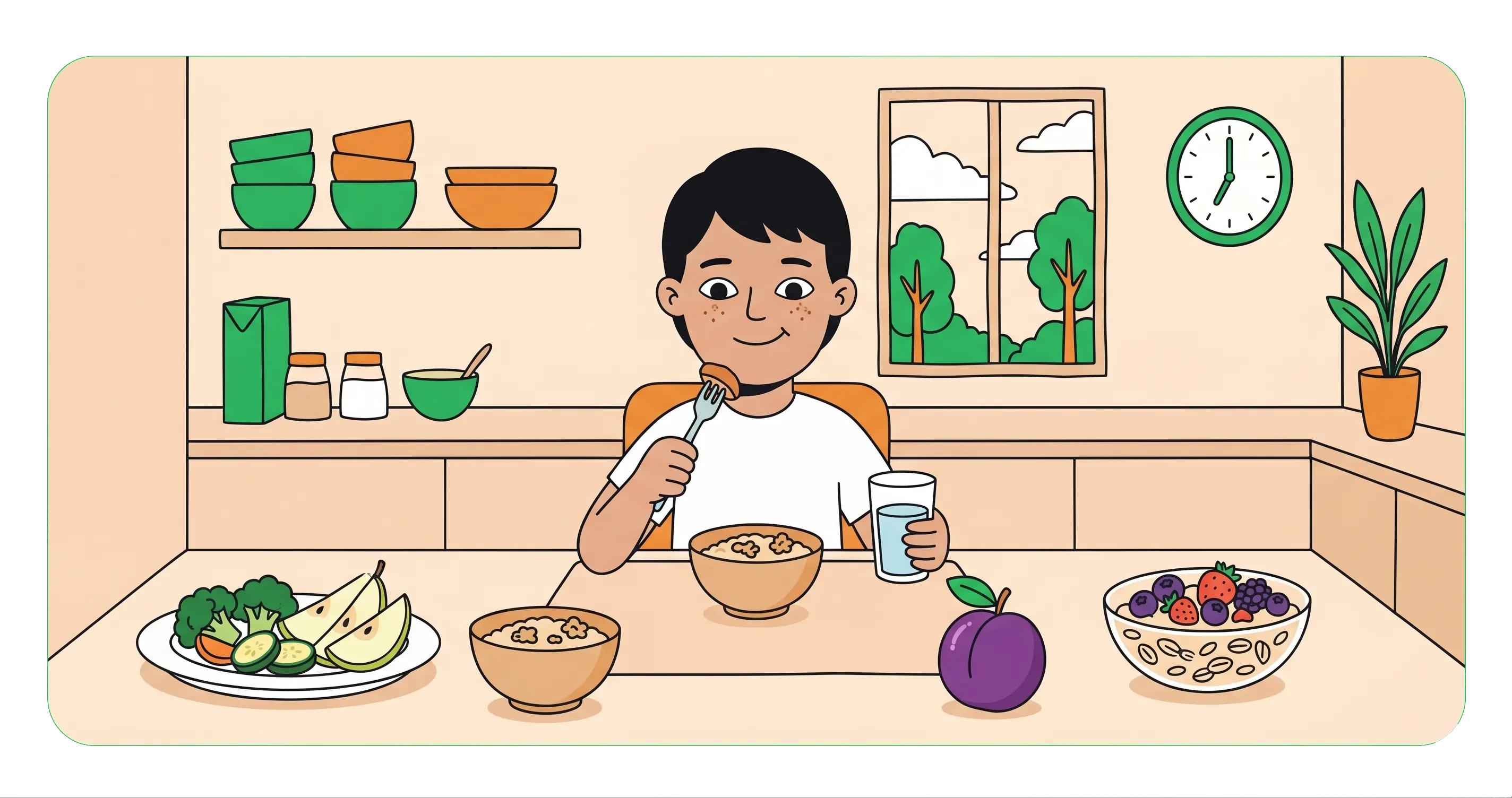
- Breakfast: oatmeal with strawberries or kiwi
- Second breakfast: bread with hummus and bell pepper strips
- Lunch: turkey meatballs, grains, and broccoli
- Afternoon snack: orange slices + lentil spread
- Dinner: lentil cream soup with bread
Child 4–6 Years
Here, we can usually build more classic meals, but it's still worth relying on familiar bases 😊
- Breakfast: egg salad sandwich with tomato
- Second breakfast: kiwi or orange + crunchy vegetables
- Lunch: buckwheat, turkey, and salad with bell pepper
- Afternoon snack: sandwich with hummus
- Dinner: lentil cream or sandwiches with egg and vegetables
Child 7–12 Years
Older children usually just need larger portions and better regularity. In practice, a rhythm of eating every 3–4 hours often helps.
- Breakfast: larger oatmeal with fruit and seeds
- Second breakfast: sandwiches with roasted meat or hummus
- Lunch: meat or legumes, grains, and a large portion of vegetables
- Afternoon snack: vegetables with hummus or turkey salad
- Dinner: lentil spread, egg, or cream soup
If your child is selective, don't try to implement everything at once. From our experience, it's much better to choose 2 meals a day to improve first, and then gradually add more changes.
When Diet Can Help, and When Not to Delay
This is a very important question. Parents often want to "try with diet" first, and that's understandable. We also like to act calmly and practically, but we also adhere to the principle that not everything can be solved with a meal plan alone.
In practice, diet can be a good support when the problem is caught early, the child eats relatively willingly, and it's possible to realistically improve the daily menu. In such situations, parents usually notice the first changes in appetite, energy, or meal organization after 2–6 weeks, and a more noticeable effect often requires several more weeks ⏳.
However, there are moments when we don't wait passively: - the child is very pale or noticeably weak, - quickly tires and has little strength for daily activities, - gains weight poorly or refuses to eat, - results are concerning, - despite 6–8 weeks of changes, no improvement is seen 🩺
We pay particular attention to children born prematurely, with low birth weight, or with a history of long-term milk-based feeding. And an important note: we don't introduce supplementation on our own. First, we need to know exactly what we're dealing with and what plan will be safe for the child.
Summary: Where to Start Today
If you want to support your child with low ferritin, you don't have to turn the kitchen upside down right away. From our experience, the best approach is a simple start: one more specific source of iron per day, add vitamin C, and fewer random combinations with large amounts of dairy. It sounds modest, but these are the steps that are easiest to maintain.
In practice, we see that parents benefit most from a plan that is ordinary and repeatable. Not perfect, not Instagram-worthy, just one that can be done even in a busy week. Because rebuilding iron reserves is more of a marathon than a sprint.
What should you watch for every day? - does the child have their usual energy, - has appetite not significantly decreased, - has paleness, drowsiness, or increased irritability appeared, - are there truly specific sources of iron in the menu.
If you want, we can help you create such a plan tailored to your child — considering age, selectivity, results, and daily home realities. You can start calmly with the NutritionHelper consultation form.