Food Neophobia in Children – A Developmental Stage or a Sign to Seek Support?
Is Your Child Rejecting New Foods and Every Meal Feels Like a Struggle? We Hear This Question Often
“My child only eats a few things. Is this still normal?” — this is one of the most common concerns parents bring to us. From our experience, the reluctance to try new things doesn't necessarily mean there's a big problem. For many children, it's simply a phase that eases over time, especially if mealtimes become calmer. 🍽️
However, in practice, we see that parents find it hardest to recognize when ordinary caution starts turning into something more persistent. One child might refuse tomatoes for a week, then suddenly start nibbling them from a parent's plate. Another might narrow its menu so much over months that preparing dinner becomes a daily stress.
In our work with families, we often repeat one thing: we don't just look at whether a child says "no," but how broadly that "no" begins to encompass everyday eating. It's also important to see if the difficulty passes or becomes more entrenched. And that's what this article is about.
In this text, we'll show you: - how to distinguish a typical phase from a warning sign, - when it's worth giving yourself a few weeks of calm work at home, - and when it's better not to delay a consultation.
When Is Reluctance to New Foods Still Within Norms?
From our experience, food neophobia often looks quite characteristic: a child doesn't trust new products but relies on a group of tried-and-true items. It's not about a complete refusal to eat, but rather caution towards the unfamiliar. For parents, this can be frustrating, but in itself, it doesn't have to be alarming.
In practice, we often see a child who says "no" to a new salad but has no problem eating bread, yogurt, some fruits, selected vegetables, and some type of protein. This picture is usually more reassuring than a situation where only 4–5 very specific products are accepted. It's not about a single refusal, but the entire eating pattern. 🙂
Parents often ask us if variability is something bad. And here's the good news: with developmental caution, variability is quite typical. Today, the child pushes the plate away, in a few days it touches the novelty, and a week later it licks it out of curiosity.
We most often see this between ages 2 and 6. It's a time when children strongly cling to what's known, predictable, and "safe." In practice, many families breathe a sigh of relief when they realize their preschooler isn't "difficult," but simply going through a phase of greater caution.
If for several weeks you mainly see reluctance to new things, but the child still eats a variety of foods even if in a limited range, it's usually worth acting calmly. However, if the list of accepted items becomes increasingly shorter, then we start to be more vigilant.
Food Neophobia vs. Selective Eating – Where Is the Line?
Parents often lump everything together and simply say: "picky eater." From our experience, that's not enough, because caution towards new things is different from rigidly eating only a few specific things. This distinction really helps in choosing the right next steps.
In practice, with neophobia, a child usually rejects what it doesn't know yet or hasn't seen in a while. With greater selectivity, the problem also involves well-known things. It happens that a child once ate pancakes but now only accepts one version: thin, without toppings, served on the same plate.
It's this rigidity that catches our attention the most. If a child only agrees to a specific brand, shape, temperature, or way of serving, we usually see that it's more than just ordinary caution. In practice, such situations rarely resolve themselves by "waiting it out."
From our experience, time is also important. If after 6–8 weeks of calm actions at home there's no easing, or it even gets worse, it's worth looking at it more broadly. ⏳
Quick Checklist: When Does a Warning Light Go On for Us?
Check if you see several of these points in your child at once:
- very short list of accepted products,
- rejection of entire food groups,
- acceptance of only one version of a product,
- strong reaction to smell, lumps, temperature, or appearance,
- increasing rigidity instead of gradual familiarization,
- previous difficulties with feeding or diet expansion.
If this sounds familiar, it doesn't immediately mean something very serious. But from our experience, it's a moment when it's worth stopping guessing and looking at the topic more concretely.
Why Doesn't a Child Want to Try New Foods?
This question comes up in almost every consultation. And honestly? The answer is very rarely: "because they're stubborn." In our work with families, we much more often see that behind the refusal is a real difficulty, not the child's ill will.
Sometimes It All Started Much Earlier 👶
In practice, many children who later eat very cautiously had a more challenging start. There were tense feedings, problems with sucking, high stress with the bottle, or a difficult transition to solid foods. If eating was associated with effort from the beginning, the body often holds on more tightly to what's known later.
We remember a boy whose parents heard for a long time that "he'll grow out of it." When we sat down for a full interview, it turned out that even in infancy, feeding was a struggle, and lumps from the start triggered a strong defensive reflex. For the parents, it was an important moment: they saw that the current difficulties didn't come out of nowhere.
High Sensitivity to Texture, Smell, and Temperature Also Plays a Role
Some children perceive food much more intensely than we assume. For us, puree and cream soup might be "almost the same," but for a child, they're two completely different experiences. From our experience, this is often where the answer lies as to why a child accepts one thing but not something very similar.
In practice, we see this every day: a child eats one yogurt, but a different flavor or slightly thicker consistency is already rejected. Or they like crunchy bread, but soft rolls evoke aversion. This doesn't have to be caprice — it's often a matter of sensory perception.
Sometimes You Need to Check Health First
There are also situations where we don't start with working on new things, but by ensuring the child isn't experiencing discomfort. If eating is accompanied by pain, frequent regurgitation, vomiting, constipation, diarrhea, or poor weight gain, it's first worth consulting with the child's doctor.
In practice, we see that when eating is associated with pain or tension in the body, the child naturally starts to avoid it. And then mere "encouragement" changes little.
The Atmosphere at the Table Really Matters
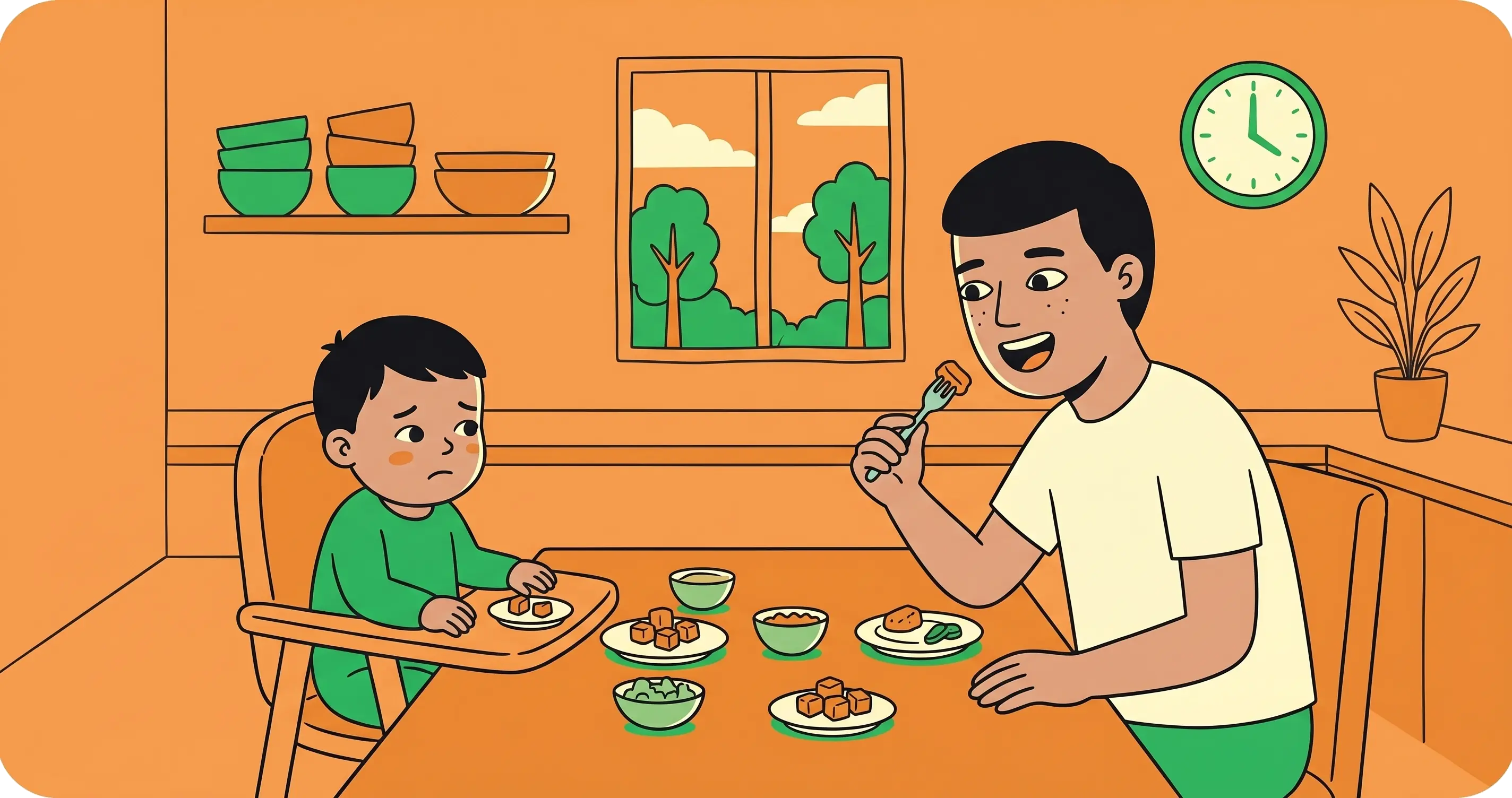
This is one of those topics where parents often immediately have tears in their eyes because they try so hard. From our experience, pressure, haste, and constant urging usually worsen the situation, even if they stem from care. The child starts associating the meal not with eating, but with tension.
In practice, after just 2–4 weeks of a calmer approach, many families tell us: "He still doesn't eat much more, but at least he stopped running away from the table." And that's really an important step.
Red Flags – When Is It Not Worth Waiting?
We don't want to scare, but there are moments when mere observation isn't enough. From our experience, it's worth speeding up a consultation when the difficulty starts affecting not only the menu but also the child's and the whole family's daily functioning. 🚩
The situations that catch our attention the most are when: - the list of accepted products is very short, - the child rejects entire food groups, - accepts only a specific brand, shape, temperature, or packaging, - reacts with strong tension at the mere sight of new things, - there's weakness, paleness, constipation, or great fatigue.
We also pay special attention to children who have had feeding difficulties from the start. In practice, this is often where a fuller picture emerges: it's not just about "being picky," but a longer history of difficulties.
Don't wait for a consultation either when you see: - gag reflex with lumps or pieces, - choking or frequent gagging, - holding food in the mouth, - clear reluctance to chew, - very strong reaction to the structure or smell of a meal.
If there's pain when eating, vomiting, frequent choking, or poor growth, first contact the child's doctor. This is more important than home attempts.
In our work with families, often after just 1–2 meetings, it's clear whether we're dealing with a phase that needs gentle guidance or a difficulty requiring a more concrete plan.
How Many Times Do You Need to Show a Child a New Product?
This is probably one of the most human questions because after the tenth refusal, you can really get fed up. Parents often tell us: "How many more times do I have to slice this cucumber if he won't even look at it?" From our experience, familiarizing with food usually takes longer than parents expect. 🌱
In practice, for many children, the first acceptance appears after about 8–15 calm contacts with the product. Sometimes sooner, sometimes much later. If a child has higher sensitivity or bad associations with food, this process can stretch over weeks or even months.
It's very important to understand "contact" more broadly. It doesn't have to be eating a portion right away. In our work, we often celebrate steps like: - looking at a new product, - touching it, - smelling it, - licking it, - putting it in the mouth and spitting it out.
Yes, spitting it out can also be progress. For many parents, this is surprising, but in practice, such small steps later build greater ease with eating.
We most often recommend contact with novelty 2–4 times a week. This is usually better than a daily struggle. From our experience, a small piece of new vegetable next to a familiar meal works better than the big expectation that "today he'll finally eat normally."
Parents often notice the first small changes after 2–3 weeks, and greater improvement only after several months. It's not a quick process, but with a calm approach, it can really move forward.
How to Encourage Trying Without Pressure?
In practice, the best results come not from urging, but from regular familiarization. A child is much more willing to approach food when they feel they don't have to do anything. It sounds simple, but for many families, it's a huge change. 😊
Start Even Before You Sit at the Table
You can familiarize with new food already during shopping. Instead of asking: "Will you eat this?", it's better to give the child a small task. This way, they have contact with the product, but without the pressure that they'll have to try it soon.
You can say: - "Can you hand me two tomatoes?" - "Let's choose a cucumber together." - "Which pepper is heavier?"
In practice, after 1–2 weeks of such small actions, some children start to touch products they previously avoided more willingly.
In the Kitchen, Focus on Exploring, Not Eating
From our experience, simply describing food without judgments like "delicious" or "you must try it" helps a lot. For a child, it can be safer to neutrally name what they see and feel.
For example: - "This is soft." - "This smells strong." - "This is crunchy." - "This is warm."
We remember a girl who didn't even want kiwi on her plate for two weeks. The breakthrough came not when someone urged her, but when she got a butter knife and could simply touch the fruit and look at the inside. For the parent, it seemed "little," but for her, it was a huge step.
Serve Novelty Next to Familiar Food
In practice, a simple arrangement works very well: safe food plus one small novelty next to it. We don't mix everything together and don't make the new product the main star of the meal.
A good scheme is: 1. serve a very small portion of the novelty, 2. place it next to, not in the middle of the favorite dish, 3. leave the decision to the child on what to do with it.
This really makes a difference. The child sees the new product but doesn't feel that someone "ruined" their safe meal.
How to Respond When a Child Refuses?
Here, the most helpful thing is simple calmness. In practice, we recommend short, neutral statements, without explanations and without negotiations.
You can say: - "You don't have to eat it." - "You can just look at it." - "If you want, you can touch it." - "Not today, we'll come back to it another time."
Lack of pressure doesn't mean giving up. It means that you're building a safer relationship with food step by step.
How to Arrange Meals and Daily Rhythm for a Calmer Table?
From our experience, parents often look for a "magic way" to new tastes, while a lot changes with the daily structure itself. When meals are predictable, it's easier for the child to get into the daily rhythm and also easier to work on new things. 🍽️
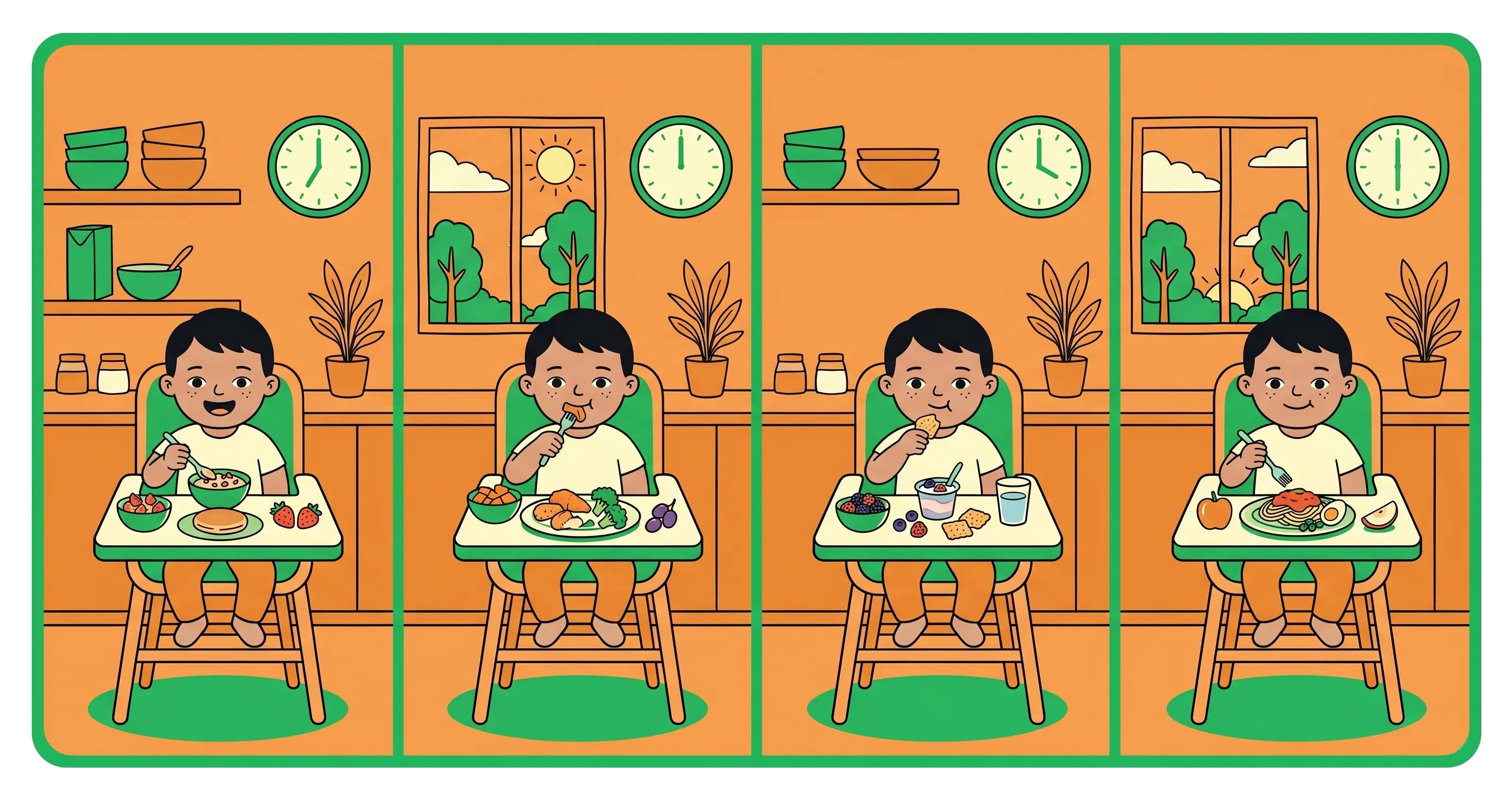
In practice, we most often recommend a simple scheme: 3 main meals and 2–3 snacks at roughly similar times. It's not about pharmacy precision, but about predictability. A child who snacks all day usually finds it much harder to sit down at the table with real hunger.
It helps: - breakfast, lunch, and dinner at similar times, - 2–3 planned snacks, - limiting constant snacking between meals, - water available daily, - avoiding filling drinks just before eating.
At the meal itself, a setup of 1–2 safe elements and a small novelty works well. This doesn't mean cooking separate meals for the child. It's more about serving the dish so that it has something familiar and something to get acquainted with on the plate.
In practice, we also see that large portions often immediately increase tension. It's better to serve less and add more if needed. For many children, the mere sight of an overloaded plate is enough reason to back away.
After 2–4 weeks of organizing the daily rhythm, parents often notice that the atmosphere at the table is lighter. Sometimes this doesn't yet mean greater variety, but it provides a much better foundation for further work.
What Most Often Perpetuates Eating Difficulties?
This is an important topic because many parents do certain things out of care, unknowingly increasing tension. From our experience, the biggest problem isn't one bad situation, but a daily repetitive pattern. 😟
Most often, what doesn't help is: - forcing "just one bite", - bribing with dessert, - commenting on the amount of food, - feeding in front of a screen, - long negotiations at the table.
In practice, the child quickly learns that the meal is a battlefield. Instead of focusing on taste, smell, or hunger signals, they focus on how to avoid tension.
What works better? Calm, neutral language. For example: - "There's rice, chicken, and cucumber on the table." - "You can choose what to start with." - "You don't have to eat everything."
In our work with families, we often see that when the parent lets go of the pressure, the child doesn't suddenly start eating perfectly. But they start to be calmer at the table. And that's a very important first step.
Dessert is also worth treating more ordinarily. If it becomes a reward for dinner, its "power" automatically increases. In practice, it's better when it's not a bargaining chip, but a regular part of everyday life.
Myths That Only Add Stress to Parents
One of the most common phrases parents hear is: "When they're hungry, they'll eat". From our experience, this doesn't always work. For some children, hunger helps, but for others — especially those with high tension or sensitivity — it makes eating even more difficult.
The second myth is: "They're controlling you" or "They're just making it up". In practice, we much more often see a child who can't handle something sensory-wise or is afraid of an unpleasant experience. This is a huge difference because it changes the way a parent reacts.
We also often hear that you have to "be tough" and consistently force trying. From our experience, this approach usually ends with more resistance, not more openness. Calm repetition works better than pressure.
If you want to better understand your child, for a few days simply note: - what they avoid, - what they react to with tension, - what textures they accept, - whether the problem concerns smell, temperature, appearance, or mixing ingredients.
Such simple observation very often organizes the situation more than the general label "picky eater."
Summary: When to Act at Home and When to Seek Help?
If your child is reluctant to try new foods but still has a few safe products from different groups and with a calm approach occasionally makes small steps, you can often start by working at home. From our experience, regularity, lack of pressure, and patient familiarization with new things over several weeks help a lot. 🙂
However, if you see that the menu is becoming increasingly sparse, the child rejects entire food groups, accepts only very specific versions of products, or reacts with strong tension at the mere contact with novelty, it's worth looking at it more closely. The same applies to situations where there are difficulties with biting, chewing, holding food in the mouth, or very strong sensitivity to texture.
And if there's choking, frequent gagging, pain when eating, vomiting, or poor growth, first contact the child's doctor. Here, it's not worth acting solely on your own.
If you want to calmly discuss your child's situation and get a plan tailored to your daily life, you can use our consultation form.