Allergens in Your Baby's Diet – How to Introduce Them Calmly
Worried About Eggs, Fish, or Nuts? You're Not Alone
Parents often tell us that expanding their baby's diet was going smoothly... until eggs, fish, gluten, or nuts came into the picture. Suddenly, instead of feeling relaxed, they think, "Maybe I'll wait a bit longer?" If you feel the same, you're definitely not alone. 🙂
From our experience, the issue rarely stems from a lack of basic knowledge. More often, it's the conflicting advice surrounding allergens that leaves parents feeling like one wrong move could ruin everything. We also see that the longer the topic is postponed, the more tension builds.
The good news is that you don't need to make this a complicated project. A simple plan works best: calmly, step by step, without pressuring yourself to do everything perfectly and immediately. 🥄
In this article, we'll show you how to organize this process. We'll discuss when to typically start, how to introduce specific allergens, what to observe, and when it's better to establish a personalized plan first.
When to Start Introducing Allergens
Parents often ask if they should hold off on allergens. In our work with families, we usually find that for healthy infants, a good time is at the start of diet expansion, typically around 6 months of age. More important than a specific date is whether the child is ready for new foods.
What to look for in practice? - the child sits more stably with support, - shows interest in food, - opens their mouth for a spoon or wants to join in meals, - can swallow appropriate textures.
This is important because there's no single "magic day" when everything must be introduced. From our experience, it's better to think of this as a calm stage, not a race against the calendar.
For many families, a general direction works well: - egg – quite early, in well-cooked or well-set form, - gluten – in small amounts once diet expansion has started, - fish – in the early months of trying new flavors, - nuts – only in a safe form, never whole.
However, we clearly see in practice that not every child should follow the exact same pace. If your child has already had a concerning reaction to food, has severe skin changes, or you've had a difficult experience with another food, it's worth establishing a plan first rather than trying on your own.
How to Do It Simply and Calmly
If we had to point out one rule that organizes the topic best, it would be: one new thing at a time. So if you're trying eggs today, don't add a new cereal, fruit, and yogurt "just to get it over with." This makes it much easier to see how your child reacts. 😊
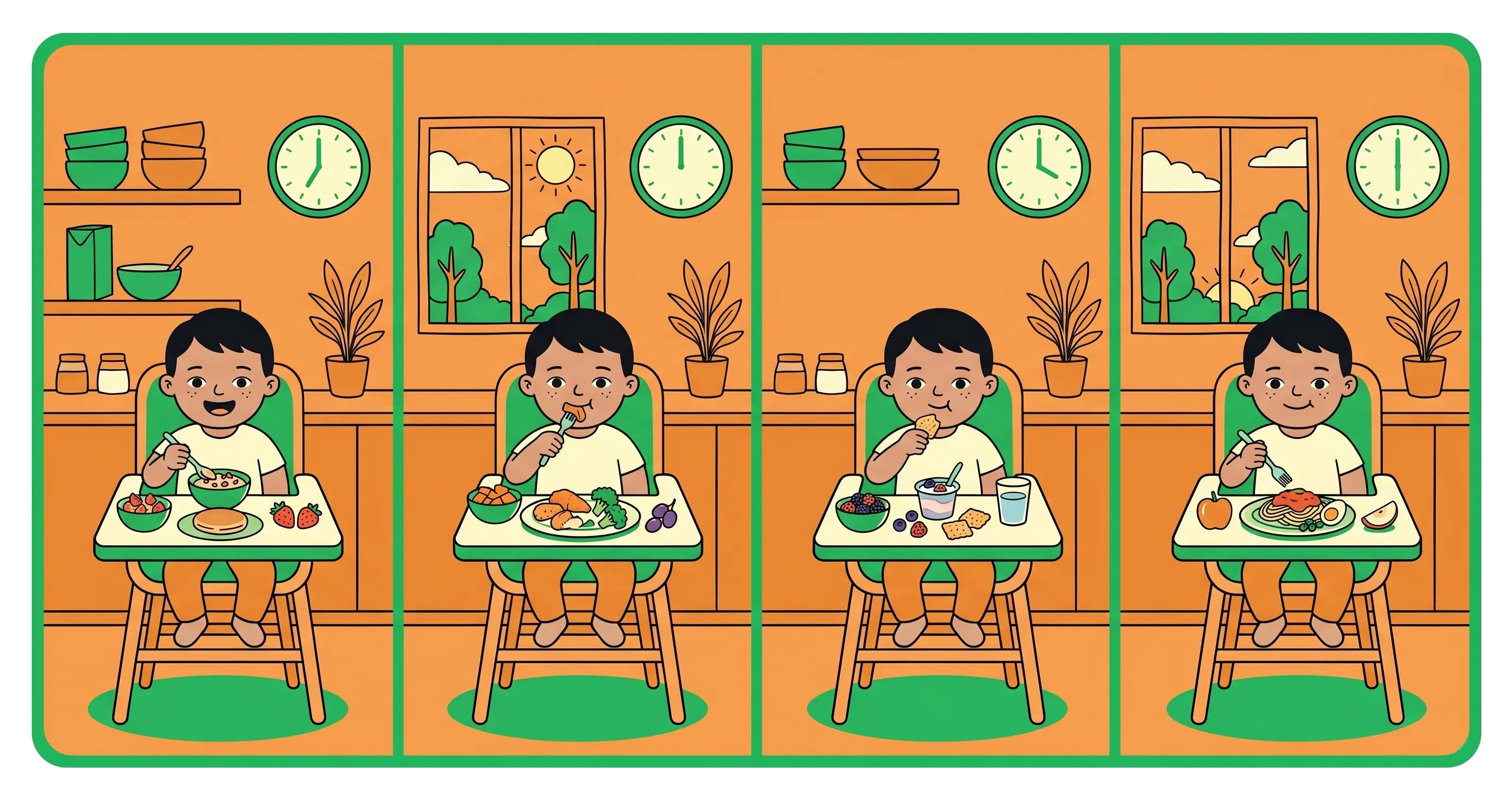
In practice, we recommend choosing: - a calm day at home, - morning or early afternoon, - when your child is healthy and in good shape.
It's not the best time when your child has an infection, diarrhea, is very irritable, or their skin is flaring up. On such days, it's harder for both the child and the parent to assess anything sensibly.
To start, a small contact with the new product is really enough. For many families, it works well to: - start with 1/4–1/2 teaspoon, - adjust the texture to the child's age, - serve it with something the child already knows and tolerates well.
From our experience, it's often the too-large portion at the start that adds stress for parents. You don't need to "feed properly" to consider the product introduced. At the beginning, it's more about calm familiarization.
How to Serve Eggs, Fish, Gluten, and Nuts
Egg
In practice, it's easiest to start with a well-cooked or well-set egg. You can add a small amount to vegetable puree, cereal, or mash it so the texture is easy for the baby.
In our work with families, there's often a misunderstanding: the child ate only the yolk, so the parent considers the topic closed. But in practice, that's not the same as calmly introducing the whole egg.
To start, a tiny bit is usually enough, and if everything is fine, the portion can be gradually increased with subsequent servings. There's no need to rush — in the first days, regularity matters more than quantity.
Gluten
With gluten, a small, ordinary addition works best, not a full portion of a new dish. It could be a bit of cereal or a small amount of a soft-textured grain product.
Parents sometimes ask if they need to hit a specific day or give "exactly the right amount." From our experience, that's not the way. It's better to think of gluten as another ingredient in the menu, introduced calmly and without rush.
Fish
Fish is best served well-cooked or baked, thoroughly broken down, and boneless. The simpler, the easier: no breading, no frying, and no heavy additives. 🐟
In practice, parents often feel more apprehensive about fish than other products, so we especially encourage small steps here. You really don't need to start with a "normal dinner." A symbolic portion is enough to begin.
Nuts
With nuts, the rule is very simple: never whole. This is not only about tolerance but also about eating safety.
We often recommend smooth peanut butter diluted with something the child already knows — for example, in cereal or puree. From our experience, this is the calmest form to start with, as it's easy to give a small amount and assess the reaction.
We also remember one important thing: if you're adding peanut butter to a meal, that meal should already be familiar to the child. We don't add two question marks at once.
How Long to Wait and How to Reinforce Tolerance
This is one of the most common questions: "If I give an egg today, when can I introduce something else?" For many families, a short observation break, usually about 2–3 days, works well. This gives parents a sense of order and doesn't turn the week into a series of random tests.
At the same time, from our experience, not every family needs a rigid daily schedule. Some homes work well with a weekly plan, while others do better with a clear rule: one new thing, observation, then another.
An example of a simple rhythm might look like this: - week 1 – gluten, - week 2 – egg, - week 3 – fish, - week 4 – nuts in a safe form.
If a product is accepted calmly, it's worth returning to it. In practice, we often suggest parents include it 2–3 times a week in small amounts. This way, it doesn't remain a one-time "test" but becomes a normal part of the menu.
And this is a moment that surprises many parents: the first introduction is just the beginning. In practice, the greatest peace comes when, after a few weeks, the allergen stops being an "event" and starts being just another ingredient in the meal. For many families, this ease appears after 2–4 weeks of regular, calm action.
What Symptoms to Observe After a New Product
Parents often ask us what is still worth calmly observing and what should immediately raise a red flag. And that's a very good question because not every change after eating means a serious problem, but we also don't want to overlook anything.
If after a new food, you notice, for example: - slight redness around the mouth, - a single rash, - looser stool, - increased fussiness, - spitting up,
it's worth holding off on giving that product again the same day and calmly observing your child. From our experience, it helps a lot to note down three things: what was given, how much, and at what time. Later, it's much easier to revisit the situation without chaos in your mind.
In practice, we recommend a simple plan: 1. Do not give the product again the same day. 2. Observe your child for the next few hours. 3. Note the symptoms and when they appeared. 4. If the situation repeats or worsens, contact a doctor.
There are also symptoms where we don't wait and see "if it will pass on its own." Urgent help is needed for: - swelling of the lips, tongue, or eyelids, - difficulty breathing, wheezing, shortness of breath, - rapidly worsening hives, - repeated vomiting, - significant weakness or sudden deterioration of the child's condition. 🚨
If something like this has happened before after eating, it's not worth trying again on your own. In such a situation, it's best to first establish a safe plan for further action.
Is It Better to Wait With Allergens "Until Later"?
In practice, we often hear: "Maybe not now, maybe next month will be safer." It's understandable because postponing gives a momentary sense of relief. The problem is that it's usually only temporary.
From our experience, for healthy infants, delaying the topic usually doesn't simplify the situation. On the contrary — parents become more tense because each passing week builds the belief that the allergen is something exceptionally dangerous and difficult. And the greater the tension, the harder it is to start.
In the clinic, we regularly see similar patterns: - a parent waits "for a calmer week," which never comes, - wants to introduce the allergen only when everything is perfect, - sticks almost exclusively to vegetables and a few safe products for months, - and then fears practically every next step.
In our work, it's best not to wait for the perfect moment but to choose a good enough day. That is, a day when the child is healthy, you're at home, and you can calmly observe what's happening. That's really enough. 🙂
Common Mistakes That Only Add Stress
In practice, we see a few recurring pitfalls. And it's worth talking about them not to judge anyone, but to simply make it easier for you.
The most common problems are: - several new things in one day, - too large a portion to start, - form inappropriate for the child's age, - introducing new things in the evening or outside the home, - very long breaks after a product has been well accepted.
From our experience, one of the most stressful scenarios looks like this: a parent gives a new allergen, then doesn't return to it for several weeks, and at the next introduction feels like they're starting all over again. That's why later, regular, calm repetition is so important.
If you feel confused, return to the simple minimum: - one new thing at a time, - very little to start, - known meal as a base, - calm day at home, - regular return to the tolerated product.
Eczema, Family Allergy, and Previous Reactions – When to Slow Down
Parents often ask if with eczema or a family allergy history, they should completely refrain from introducing allergens. In practice, it's usually not about refraining, but about a more cautious pace and better organization. 👶
If the child only has a family history, a calm home plan can often be arranged. However, with severe skin changes, previous reactions to food, suspected allergy, or already diagnosed allergy, it's usually worth acting more cautiously and not improvising.
In such situations, it especially helps to: - choose a day when the skin is in a calmer state, - introduce new things in the morning or afternoon, - start with a really small amount, - avoid other new products that day, - have a longer observation before the next new thing.
From our experience, parents really need not "more theory," but a concrete plan: what to give, how much, in what form, and when to return to the product. And that makes sense — because when emotions are high, a simple scheme provides great relief.
We also remember that the parent's stress itself is important. If after a previous reaction you're afraid to give the next product, it's not an exaggeration. It's a signal that it would be good to organize this process so you're not acting under tension and guessing.
Summary: Not Perfection, Just a Simple Plan
If we leave you with one thought, it's this: you don't need a perfect calendar, just a calm way of acting. In practice, it's this simplicity that gives parents the most sense of security.
The most important steps are: - start when the child is ready to expand their diet, - introduce one new product at a time, - start with very small amounts, - choose a safe form of serving, - test new things at home and during the day, - regularly return to well-tolerated products.
From our experience, even very stressed parents say after a few weeks that the topic of allergens is not as scary as it seemed at first. And that's what we wish for you — less tension, more clarity, and the feeling that you know what to do step by step. 🤍
If you want, we can help you create such a plan for your child and your daily life. Fill out the consultation form, and together we'll organize allergen introduction without chaos and without guessing.