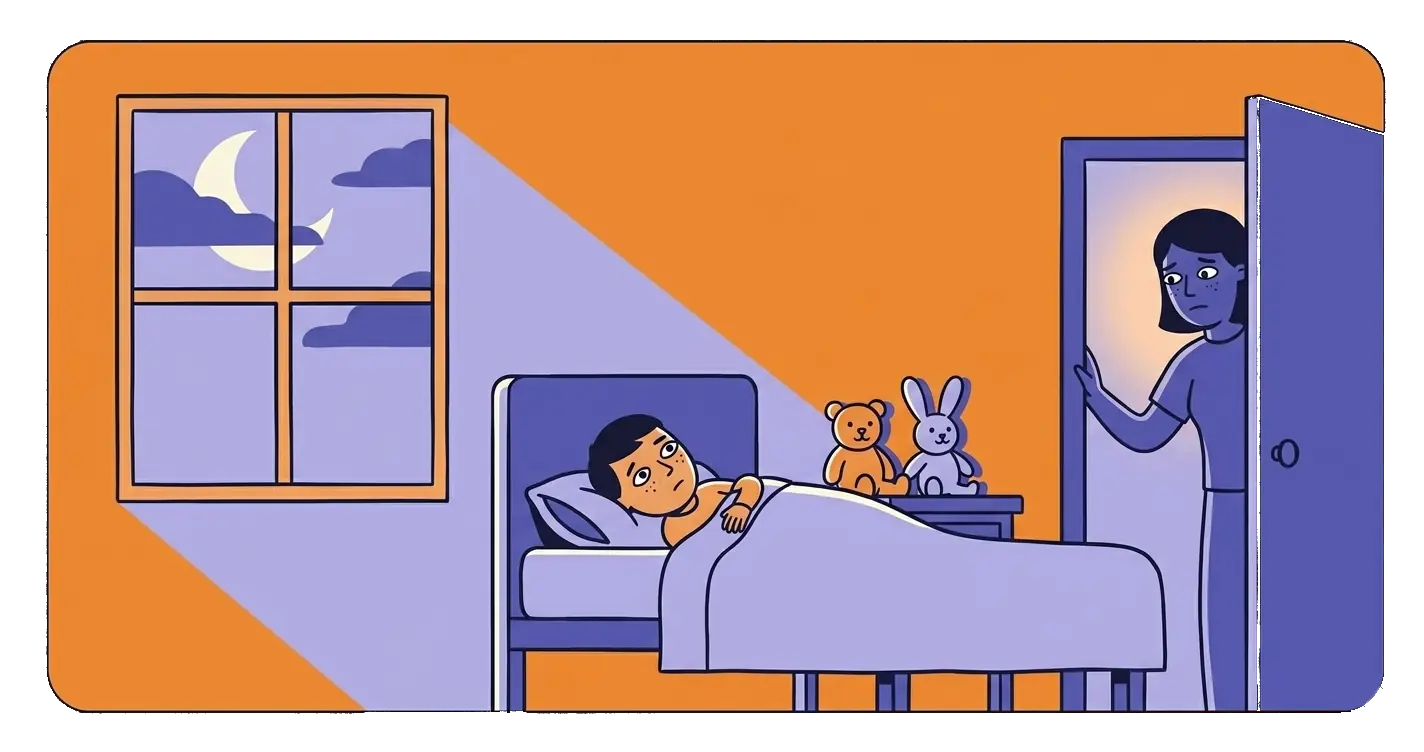
Are frequent infant night wakings normal?
Night wakings are a natural part of an infant's sleep. Young children's sleep is shorter and more variable than adult sleep, and between cycles, movements, murmurs, brief eye-opening, or crying may occur. Not every activity indicates a full awakening requiring parental intervention. In the first year of life, the organization of sleep gradually changes, but the pace of these changes is individual [4].
Whether wake-ups fit within typical development is not determined solely by their number. Important factors include:
- the child's age and developmental stage,
- breathing patterns and behavior during wake-ups,
- the need for feeding,
- weight gain rate,
- ease of falling back asleep,
- the child's daytime well-being.
It's important to clearly distinguish three situations: physiological awakenings related to sleep maturation, difficulties reinforced by conditions or sleep habits, and wake-ups due to illness, pain, or breathing problems. Each requires a different approach.
What does infant sleep look like in the following months?
0–3 months: sleep and feeding without a fixed rhythm
In the first weeks, the day and night rhythm is still forming. Sleep is usually divided into many segments, and regular feedings — including night ones — are necessary for most babies. A newborn may sleep noisily, fidget, and make short sounds while still in the sleep phase.
During this period, priorities are proper feeding, weight gain, responding to the child's signals, and safe sleep conditions. Do not independently extend the intervals between feedings if a pediatrician or midwife has advised waking the baby due to age, jaundice, prematurity, or insufficient weight gain.
4–6 months: sleep organization changes
Around this time, sleep becomes more organized, and transitions between its phases may be more noticeable. A child who previously slept in longer segments may wake more frequently for a while. This is not proof of a parental mistake.
However, if after each short awakening the infant needs exactly the same conditions in which they fell asleep — such as intense rocking — the sleep habit may contribute to the difficulty. In literature, such entrenched problems are described as behavioral sleep difficulties, but diagnosis requires considering age, feeding, health, and the entire family's situation [1].
7–12 months: the importance of the entire daily plan
In the second half of the first year, night sleep can be influenced by naps, bedtime, new motor skills, teething, infections, and a greater need for closeness. However, there is still no single correct number of wake-ups for all infants.
More attention is needed when wake-ups are long, involve intense crying, significantly worsen the child's or family's functioning, or suddenly appear with other symptoms.
Normal awakening, behavioral difficulty, or health problem?
Age-typical awakenings
Physiological awakening is more likely when the child:
- briefly moves, murmurs, or opens their eyes,
- falls back asleep after feeding or a short calming,
- breathes freely and has normal skin color,
- is appropriately active for their age during the day,
- eats well, urinates, and gains weight properly.
Difficulties related to daily rhythm or sleep habits
Behavioral factors may be indicated by wake-ups occurring in a similar pattern, especially when the child requires extensive help each time, despite showing no signs of hunger, pain, or illness. Irregular sleep times, too long wakefulness before night, or a large number of evening stimuli may also be significant.
This does not mean that feeding, carrying, or rocking are inappropriate. They become a practical problem only when the current way of falling asleep does not meet the child's needs or the family's capabilities. Behavioral methods can support children's sleep but should be tailored to age, temperament, and caregivers' preferences [3].
Wake-ups that may have a health cause
A health problem should be considered especially when sleep has suddenly worsened or wake-ups are accompanied by breathing difficulties, fever, pain, itching, poor feeding, vomiting, diarrhea, or a noticeable change in behavior. In such a situation, do not focus on sleep training before assessing health.
The most common causes of night wake-ups
Hunger and the need for feeding
Night feedings are normal for many infants, especially in the first months. Genuine hunger may be indicated by active, rhythmic sucking and relaxation after feeding. Short sucking does not always mean a lack of hunger — feeding method and effectiveness are best assessed in the context of the entire day, the number of wet diapers, and weight gain.
Do not limit night feedings based solely on age. It's best to discuss this with a pediatrician or lactation consultant, especially if the baby was born prematurely, is not gaining weight well, or there are feeding difficulties.
Discomfort and sleep conditions
A wet diaper, irritated skin, inappropriate clothing, noise, light, or overheating can hinder sleep. The bedroom should be calm, and clothing should be suited to the ambient temperature. The back of the child's neck can help assess thermal comfort; a sweaty, hot neck suggests the baby may be too warm.
Infection, pain, or itching
A stuffy nose making breathing difficult, ear infections, skin changes, fever, or gastrointestinal issues can lead to frequent wake-ups. Teething can be associated with temporary discomfort but should not automatically explain high fever, significant apathy, or breathing problems.
Developmental changes and the need for closeness
Learning new skills and increased awareness of the caregiver's presence can periodically affect falling asleep. These stages do not have a strictly defined timeline or uniform course for every child. If poor sleep persists or worsens, it's worth rechecking health, feeding, and daily rhythm.
Safe sleep is more important than extending the night
Regardless of the number of wake-ups, an infant should be placed on their back, on a firm, flat surface intended for sleep. The crib should not contain pillows, quilts, bumpers, wedges, positioners, stuffed animals, or other soft items. It is recommended that the child sleeps in their own crib or co-sleeper in the parents' room, especially in the first months of life [2].
After night feeding, it's safest to return the infant to their sleep space. Falling asleep with the baby on a couch or chair is particularly dangerous. Do not elevate the mattress or use positioners due to reflux without explicit medical advice.
When to consult a doctor or specialist?
Symptoms requiring urgent help
Call emergency services at 112 or go to an urgent care if the child:
- has breathing pauses, turns blue, is limp, or is hard to wake,
- breathes with noticeable effort, has skin pulling between ribs, grunts while breathing, or gasps for air,
- has seizures, sudden consciousness disturbances, or unusual, significant sleepiness,
- shows signs of severe dehydration, such as very little urine, sunken fontanelle, dry mouth, and noticeable apathy.
Symptoms requiring prompt contact with a pediatrician
Contact a doctor without delay if:
- the child under 3 months has a temperature of 38°C or higher,
- wake-ups are accompanied by persistent vomiting, blood in vomit or stool, diarrhea, or significantly fewer wet diapers,
- the infant refuses feeding, sucks poorly, or is not gaining weight properly,
- crying is sudden, very intense, unusual, or the child cannot be soothed,
- there is loud, regular snoring, mouth breathing, choking, or suspected breathing pauses,
- the child has extensive skin changes, severe itching, or seems to be in pain,
- sleep has suddenly worsened and the child's daytime behavior has changed.
A planned consultation is also worth considering if difficulties persist despite organizing the basics, lead to extreme caregiver exhaustion, or cause concern. A pediatrician can assess the child's health and development, and a feeding or sleep specialist can help tailor an approach to the specific situation.
Checklist: from observation to decision
Step 1. Assess the child's safety and condition
- □ Is the child breathing freely and has normal skin color?
- □ Is there no fever, unusual sleepiness, severe pain, or difficult-to-soothe crying?
- □ Is the child eating as usual and has an appropriate number of wet diapers?
- □ Are there no alarm symptoms described above?
If a red flag appears, medical help is the priority, not changing sleep habits.
Step 2. Check if the child is truly awake
- □ Is the child just murmuring, moving, or briefly opening their eyes?
- □ Is the crying escalating and the child clearly needs help?
- □ Can the child fall back asleep after a short, calm response?
If the infant is just fidgeting and not crying, you can observe for a short while. Respond to escalating crying, signs of hunger, or discomfort.
Step 3. Assess feeding and comfort
- □ Has the child had enough feeding opportunities during the day?
- □ Is the child actively eating during night feeding?
- □ Are the diaper, clothing, and ambient temperature appropriate?
- □ Is the skin not irritated, and is the nose not blocked?
Step 4. Record the day's events for 3–7 days
- □ Morning start time.
- □ Nap times and durations.
- □ Feeding times.
- □ Evening routine start and sleep time.
- □ Wake-up times and how the child falls back asleep.
- □ Symptoms of illness, teething, or unusual discomfort.
The journal doesn't need to be perfect. Its goal is to find a repeatable pattern, not to control every minute of sleep.
Step 5. Choose one safe change
If health and feeding are not concerning, choose one element to organize, such as:
- a more predictable start to the evening routine,
- less light and stimuli before sleep,
- adjusting sleep time to signs of tiredness,
- gradually reducing one element of intense help with falling asleep.
A consistent, calm routine and age-appropriate sleep times can support healthy habits but do not guarantee an uninterrupted night [5]. Evaluate the change over a few days, as long as the child is healthy and the situation does not worsen.
Step 6. Make a decision
- Observe: when wake-ups are short, the child is healthy, eats well, and functions well during the day.
- Organize basics: when there is a link with daily rhythm, evening stimuli, or sleep habits.
- Schedule a consultation: when difficulties are severe, persistent, affecting development, feeding, or family safety.
- Seek urgent help: when alarm symptoms are present.
How to gently support falling back asleep?
There is no one method suitable for every family. You can start with small, predictable steps:
- maintain a similar sequence of activities before sleep,
- limit intense light and play in the evening,
- respond calmly and in a similar way during subsequent wake-ups,
- if the family needs it, gradually reduce the intensity of rocking or carrying,
- do not limit necessary feedings without prior assessment of development and feeding methods.
Gently reducing assistance does not mean leaving the child without a response. The pace of change can be adjusted to the child's age, temperament, and parents' readiness. If the chosen method increases crying or does not suit the family, you can stop and look for another solution.
Frequently Asked Questions
Is a baby waking every hour definitely having a sleep problem?
Not always. Frequent wake-ups can be temporarily related to age, feeding, infection, or developmental changes. Their course, duration, and the child's well-being matter. If wake-ups occur almost all night, last long, or are accompanied by worrying symptoms, it's worth consulting a pediatrician.
Should you respond to every sound made during sleep?
Murmuring and brief movements do not always indicate awakening. If the child is breathing calmly and not crying, you can observe for a moment. When crying escalates, signs of hunger, pain, or breathing difficulties appear, you should respond.
Is feeding to sleep a mistake?
No. For many infants, feeding is a natural part of the evening and a way of regulation. Consider a change only when the current pattern is too burdensome for the family. Before limiting night feedings, consider age, weight gain, and medical advice.
Will putting the child to bed later make them sleep longer in the morning?
There is no such guarantee. For some children, putting them to bed too late leads to overtiredness and a more difficult night. Sleep times should consider age, naps, and individual signs of tiredness, not a rigid schedule.
When can you start changing the way of falling asleep?
First, ensure the child is healthy, effectively fed, and has safe sleep conditions. Any changes should be tailored to the developmental stage. For younger infants, responsive care remains a priority, while for older ones, more predictable rituals can be gradually introduced.
Summary
Night wakings are part of normal infant development, but not every difficult night should be explained solely by age. First, assess breathing, health, feeding, and sleep safety. Then observe the entire day's rhythm for a few days and choose one change that meets the child's needs and the family's capabilities.
If alarm symptoms, feeding deterioration, improper weight gain, or a noticeable change in behavior occur, medical consultation is needed. The goal is not to eliminate all awakenings but to ensure safe sleep for the child and find a response method that is sustainable.
Sources
- Review: Behavioral insomnia in infants.
- American Academy of Pediatrics, Safe Sleep Guidelines.
- American Academy of Sleep Medicine, review of behavioral treatment methods for sleep difficulties.
- Review of infant sleep development: Infant sleep development.
- American Academy of Pediatrics, Healthy Sleep Habits.